
Top Schools 2026 Primary 6 Mathematics Preliminary Examination Solutions Explained
With the 2026 math preliminary exams behind us, the final stretch to the PSLE is underway. It is completely natural to want your child to practice with top school questions, yet forcing them to complete full exam paper after full exam paper often leads to exhaustion and unnecessary stress when time is already tight.
We also understand how frustrating it can be when answer keys only show final steps without explaining how to actually think through the problem. That is why we built this page.
We break down selected 2026 math prelims questions step by step, complete with full working (click the button to reveal the blue text) and clear conceptual explanations to help your child build confidence without the burnout.
Click a Question to View Its Solution
| Primary School | Paper 2 Questions |
|---|---|
| Ai Tong School | 12 13:Fr 14:Vol 15:Cir |
| Anglo-Chinese School (Junior) | 10 11:% 12:Vol 13 14 15:Cir |
| Nan Hua Primary School | 11:% 13:Cir 14 |
| Nanyang Primary School | 8:Fr 9:Vol 14:Cir 15:Vol |
| Raffles Girls' Primary School | 7:% 8 13:Fr 15:Cir |
| Red Swastika School | 9:Vol 13 14:Cir 15:Fr |
| Rosyth School | 9 13 15 |
| Tao Nan School | P1-29:Vol 7:% 8 11 13:Cir 14:Fr 15:Vol |
Fandi had 20 small identical boxes and 24 large identical boxes.
He used 798 marbles to fill up 12 small boxes and 9 large boxes completely.
The number of marbles he used to fill up 5 large boxes was the same as that for 6 small boxes.
(a) How many marbles were needed to fill up a large box completely?
10 Large = 12 Small
12 Small + 9 Large = 10 Large + 9 Large = 19 Large
19 Large : 798
1 Large : 798 ÷ 19 = 42
Ans (a): 42
(b) How many more marbles did Fandi need to fill up the remaining boxes completely?
Remaining Small : 20 - 12 = 8
Remaining Large : 24 - 9 = 15
(8 × 35) + (15 × 42) = 280 + 630 = 910
Ans (b): 910
💡 Explanation for Understanding
Fandi filled 12 small boxes and 9 large boxes with 798 marbles. We were given that 5 large boxes held the same number of marbles as 6 small boxes. In part (a), our objective was to find the capacity of 1 large box. In part (b), our objective was to find how many additional marbles were needed to fill all the remaining empty boxes.
The main challenge in part (a) was converting the small boxes into equivalent large boxes so that we could solve for 1 box capacity.
5 Large boxes = 6 Small boxes.
Multiplying both sides by 2:
10 Large boxes = 12 Small boxes.
Fandi filled 12 Small boxes + 9 Large boxes = 798 marbles.
Substituting 12 Small boxes with 10 Large boxes:
10 Large boxes + 9 Large boxes = 19 Large boxes.
19 Large boxes = 798 marbles.
Capacity of 1 Large box = 798 ÷ 19 = 42.
Since 6 Small boxes = 5 Large boxes:
6 Small boxes = 5 × 42 = 210 marbles.
Capacity of 1 Small box = 210 ÷ 6 = 35.
Remaining Small boxes = 20 - 12 = 8 boxes.
Remaining Large boxes = 24 - 9 = 15 boxes.
Marbles for 8 Small boxes = 8 × 35 = 280.
Marbles for 15 Large boxes = 15 × 42 = 630.
Total additional marbles needed = 280 + 630 = 910.
Ken had some $1 coins and Jun Wei had some 50-cent coins at first.
After Ken used 14 of his coins and Jun Wei used 35 of his coins, they had the same number of coins left.
Ken and Jun Wei had a total of $81 left.
(a) How many coins did each boy have left?
81 ÷ 1.50 = 54
Ans (a): 54
(b) How much money did Jun Wei have at first?
1 - 35 = 25 = 615
6 units : 54
1 unit : 54 ÷ 6 = 9
15 × 9 = 135
135 × $0.50 = $67.50
Ans (b): $67.50
💡 Explanation for Understanding
Ken had $1 coins and Jun Wei had 50-cent ($0.50) coins. After spending part of their coins, both boys had the exact same number of coins left, totaling $81 in value. In part (a), our goal was to find the number of coins left for each boy using the Grouping method. In part (b), our goal was to find Jun Wei's starting sum of money by equating the numerators of their remaining fractions.
Since both boys had the same number of coins left, we can pair up every $1 coin Ken had left with one 50-cent ($0.50) coin Jun Wei had left into a group.
Value of 1 group = $1.00 + $0.50 = $1.50.
Number of groups = $81 ÷ $1.50 = 54 groups.
Since each group contains 1 coin from each boy, each boy had 54 coins left.
Ken's remaining fraction = 1 - 14 = 34.
Jun Wei's remaining fraction = 1 - 35 = 25.
Since the number of remaining coins is equal, we make the numerators equal by finding a common multiple of 3 and 2 (which is 6):
Ken's remaining fraction = 34 = 68.
Jun Wei's remaining fraction = 25 = 615.
The remaining coins represented 6 units for both boys.
6 units = 54 coins (from part a).
1 unit = 54 ÷ 6 = 9 coins.
Jun Wei started with 15 units of coins.
Total coins Jun Wei had at first = 15 × 9 = 135 coins.
Since all of Jun Wei's coins were 50-cent ($0.50) coins:
Money Jun Wei had at first = 135 × $0.50 = $67.50.
At first, Containers X and Y were filled with some water to the same height.
There were 30.6 ℓ more water in Container X than Container Y.

(a) What was the height of water in the two containers at first?
40 × 30 = 1200
3000 - 1200 = 1800
30.6 ℓ = 30 600 cm³
30 600 ÷ 1800 = 17
Ans (a): 17 cm
(b) Both taps A and B were turned on at the same time. Water flowed into Container X at a rate of 4.35 ℓ per minute and into Container Y at a rate of 3.6 ℓ per minute. After 2 minutes, tap B was turned off. How long did it take for tap A to fill up Container X such that the height of the water in Container X was twice the height of the water in Container Y?
2 × 3.6 ℓ = 7.2 ℓ = 7200 cm³
7200 ÷ 1200 = 6
17 + 6 = 23
Container X :
23 × 2 = 46
46 - 17 = 29
25 × 30 × 29 = 21 750
21 750 cm³ = 21.75 ℓ
21.75 ÷ 4.35 = 5
Ans (b): 5 min
💡 Explanation for Understanding
Containers X and Y were filled to the same initial height, with Container X holding 30.6 ℓ more water due to its larger base. In part (a), our goal was to find this starting water height. In part (b), water was added from taps A and B until Container X reached twice the water height of Container Y. Our goal was to find the duration Tap A needed to run.
The key challenge in part (b) was recognizing that once water in Container X rose past 17 cm (the height of its lower wide section), additional water flowed only into the narrower upper tower of base 25 cm by 30 cm.
Base Area of Container X (bottom section) = 100 × 30 = 3000 (cm²).
Base Area of Container Y = 40 × 30 = 1200 (cm²).
Difference in Base Area = 3000 - 1200 = 1800 (cm²).
Difference in volume = 30.6 (ℓ) = 30 600 (cm³).
Since both containers had the same initial height, the volume difference was created entirely by the difference in base area:
Initial height = 30 600 ÷ 1800 = 17 (cm).
Tap B ran for 2 minutes at 3.6 ℓ/min:
Volume added to Y = 2 × 3.6 = 7.2 (ℓ) = 7200 (cm³).
Increase in height of Y = 7200 ÷ 1200 = 6 (cm).
Final water height in Y = 17 + 6 = 23 (cm).
Target water height in X = 23 × 2 = 46 (cm).
Since the lower section of Container X had a height of 17 cm, any additional height above 17 cm entered the upper section.
Additional height needed in upper section = 46 - 17 = 29 (cm).
Volume needed in upper section = 25 × 30 × 29 = 21 750 (cm³) = 21.75 (ℓ).
Time taken = 21.75 ÷ 4.35 = 5 (min).
The figure is made up of identical quarter circles and a square of area 289 cm². (Take π = 3.14)

(a) Find the length of the square.
Ans (a): 17 cm
(b) Find the perimeter of the unshaded part.
Ans (b): 53.38 cm
(c) Find the total area of the shaded parts.
289 - 226.865 = 62.135
2 × 62.135 = 124.27
Ans (c): 124.27 cm²
💡 Explanation for Understanding
A square of area 289 cm² contained four overlapping quarter circles centered at its corners. In part (a), our objective was to find the side length of the square. In part (b), we determined the perimeter of the unshaded center shape. In part (c), we found the total shaded area.
The main challenge in parts (b) and (c) was avoiding complicated arc and segment formulas by shifting sections visually to form complete standard geometric shapes.
Area of square = 289 (cm²).
Side length = √289 = 17 (cm).
The unshaded central region is bounded by 4 curved arcs inside the square.

This reveals that the 4 arc boundaries of the unshaded shape combine to form exactly 2 full quadrant arcs (quarter circles) of radius 17 cm.
Perimeter of unshaded part = 2 × 14 × 3.14 × 2 × 17 = 53.38 (cm).

The rearranged shaded region consists of 2 identical corner regions, which is equal to twice the shaded area shown in Figure 4.
The shaded area in Figure 4 is simply the difference between the area of the square and the area of 1 quadrant.
Area of 1 quadrant = 14 × 3.14 × 17 × 17 = 226.865 (cm²).
Shaded area in Figure 4 = 289 - 226.865 = 62.135 (cm²).
Total shaded area = 2 × 62.135 = 124.27 (cm²).
A company hired Mr Lim to deliver melons over two days. He delivered 37 of the melons on Monday and the remaining 120 melons on Tuesday.
(a) How many melons did Mr Lim deliver in 2 days?
4 units : 120
1 unit : 120 ÷ 4 = 30
Total melons (7 units) : 7 × 30 = 210
Ans (a): 210
(b) The company paid Mr Lim $7 for every melon he delivered safely but charged a penalty of $2 for every melon he damaged. At the end of the two days, Mr Lim earned a total of $1344. How many melons did he damage?
Assumed earnings : 210 × $7 = $1470
Difference in earnings : $1470 - $1344 = $126
Difference per damaged melon : $7 + $2 = $9
Damaged melons : $126 ÷ $9 = 14
Ans (b): 14
💡 Explanation for Understanding
Mr Lim was hired to deliver melons over two days. He delivered 37 of them on Monday and the remaining 120 on Tuesday. In part (a), our objective was to find the total number of melons delivered in 2 days. In part (b), he was paid $7 for each melon delivered safely but charged a penalty of $2 for each damaged melon, earning $1344 in total. Our objective was to find how many melons were damaged.
In part (a), the challenge was linking the leftover count directly to its fractional units. In part (b), a common mistake was subtracting $2 from $7 to get a $5 difference per damaged melon, forgetting that a damaged melon lost both its $7 earnings and incurred a $2 penalty, creating a total loss of $9. We applied the Supposition concept for part (b).
The total melons represented 1 whole (77).
Tuesday's fraction = 1 - 37 = 47.
We knew that 4 units represented the 120 melons delivered on Tuesday.
1 unit = 120 ÷ 4 = 30 melons.
Total melons (7 units) = 7 × 30 = 210 melons.
If all 210 melons were delivered safely, his total earnings would be:
210 × $7 = $1470.
His actual earnings were $1344.
Difference in earnings = $1470 - $1344 = $126.
When 1 safe melon became a damaged melon, Mr Lim lost the $7 fee he would have earned plus had to pay $2 in penalty.
Loss per damaged melon = $7 + $2 = $9.
Number of damaged melons = $126 ÷ $9 = 14 melons.
An electronics store has 1500 digital devices for sale. 35% of them were smartwatches and the rest were fitness trackers.
(a) How many smartwatches did the electronics store have?
Ans (a): 525
(b) Some fitness trackers were sold. In the end, 30% of the digital devices left in the store were fitness trackers. How many fitness trackers were sold?
End smartwatch percentage : 100% - 30% = 70%
70% of final total : 525
1% of final total : 525 ÷ 70 = 7.5
Fitness trackers left (30%) : 30 × 7.5 = 225
Fitness trackers sold : 975 - 225 = 750
Ans (b): 750
💡 Explanation for Understanding
An electronics store started with 1500 digital devices, where 35% were smartwatches and the rest were fitness trackers. In part (a), our objective was to find the number of smartwatches. In part (b), some fitness trackers were sold until fitness trackers made up 30% of the remaining devices. Our objective was to calculate how many fitness trackers were sold.
The main challenge in part (b) was recognizing that the number of smartwatches remained unchanged throughout the sale. A common mistake was calculating the final 30% using the starting total of 1500 devices rather than the new, reduced total.
We calculated 35% of the total 1500 devices.
35100 × 1500 = 525 smartwatches.
Fitness trackers at first = 1500 - 525 = 975.
Since only fitness trackers were sold, the number of smartwatches remained 525.
In the end, fitness trackers made up 30% of the remaining devices, which meant smartwatches made up 100% - 30% = 70% of the final total.
70% of final total = 525.
1% of final total = 525 ÷ 70 = 7.5.
Fitness trackers left (30% of final total) = 30 × 7.5 = 225.
Fitness trackers sold = 975 - 225 = 750.
G and H are two rectangular containers.
The base of Container G measures 8 cm by 10 cm and it is filled with water to a height of 43 cm.
Container H has a square base of sides 5 cm and it contains 760 cm³ of water.
Nigel poured water from Container G into Container H without spilling until the heights of the water level in both containers are the same.
What is the volume of water poured into container H?
Base Area H : 5 × 5 = 25
Volume G at first : 80 × 43 = 3440
Total volume of water : 3440 + 760 = 4200
Total Base Area : 80 + 25 = 105
New equal height : 4200 ÷ 105 = 40
Final Volume H : 25 × 40 = 1000
Volume poured into H : 1000 - 760 = 240
Ans: 240 cm³
💡 Explanation for Understanding
Two containers G and H contained initial volumes of water. Water was poured from G into H until the water level in both containers reached the exact same height. Our objective was to find the volume of water poured into H.
The main challenge was realizing that when both containers shared the same water height, they acted as a single combined container. A common mistake was attempting to guess water heights instead of dividing the total water volume by the combined base area. We applied the Combined Base Area concept.
Base Area G = 8 × 10 = 80 (cm²).
Base Area H = 5 × 5 = 25 (cm²).
Volume G at first = 80 × 43 = 3440 (cm³).
Total volume of water = 3440 + 760 = 4200 (cm³).
Total Base Area = 80 + 25 = 105 (cm²).
New equal height = 4200 ÷ 105 = 40 (cm).
Final Volume H = 25 × 40 = 1000 (cm³).
Volume poured into H = 1000 - 760 = 240 (cm³).
A courier company charges the following postage fees for parcels sent to Japan in a particular month:
| Parcel Type | Weight category | Postage Fee |
|---|---|---|
| Big parcel | 5 kg and above | $17 |
| Below 5 kg | $13 | |
| Small parcel | Below 2 kg | $9 |
The number of big parcels sent was 3 times the number of small parcels sent.
49 of the big parcels sent weighed below 5 kg. A total of $2132 was collected from postage fees.
(a) What fraction of the total number of parcels sent weighed 5 kg and above? Give your answer in the simplest form.
Small parcels : 3 parts
Total parcels : 9 + 3 = 12 parts
Big parcels below 5 kg : 4 parts
Big parcels 5 kg and above : 9 - 4 = 5 parts
Fraction 5 kg and above : 512
Ans (a): 512
(b) What was the total number of parcels sent?
5 × $17 + 4 × $13 + 3 × $9
= $85 + $52 + $27 = $164
Number of sets : $2132 ÷ $164 = 13
Total parcels : 13 × 12 = 156
Ans (b): 156
💡 Explanation for Understanding
A courier company charged postage fees based on parcel size and weight categories. In part (a), our objective was to find what fraction of the total parcels weighed 5 kg and above. In part (b), $2132 was collected in total, and our objective was to find the total number of parcels sent.
The main challenge in part (a) was choosing a suitable number of parts to represent the big and small parcels so that 49 could be calculated cleanly. A common mistake in part (b) was multiplying fees directly by unit counts without forming grouped sets. We applied the Grouping concept.
The number of big parcels was 3 times the small parcels.
Since 49 of the big parcels weighed below 5 kg, we let the number of big parcels be 9 parts.
This meant the number of small parcels = 9 ÷ 3 = 3 parts.
Total number of parcels = 9 parts + 3 parts = 12 parts.
Number of big parcels below 5 kg = 4 parts.
Number of big parcels 5 kg and above = 9 parts - 4 parts = 5 parts.
Fraction weighing 5 kg and above = 512.
5 Big parcels (5 kg and above) : 5 × $17 = $85.
4 Big parcels (below 5 kg) : 4 × $13 = $52.
3 Small parcels (below 2 kg) : 3 × $9 = $27.
Total fee for 1 set of 12 parcels = $85 + $52 + $27 = $164.
Number of sets = $2132 ÷ $164 = 13 sets.
Total parcels sent = 13 × 12 = 156 parcels.
Jasmine bought some tuna pies and chicken pies.
38 of them were tuna pies and the rest were chicken pies.
The cost of a chicken pie was $0.50 less than the cost of a tuna pie.
She spent a total of $456 buying both tuna and chicken pies.
The total cost of the chicken pies was $24 more than the total cost of the tuna pies.
(a) What was the total cost of the tuna pies?
Cost of tuna pies : ($456 - $24) ÷ 2 = $216
Ans (a): $216
(b) How much did each tuna pie cost?
Cost of 3 units of tuna pies : $216
Cost of 1 unit of tuna pies : $216 ÷ 3 = $72
Cost of 5 units of chicken pies : $216 + $24 = $240
Cost of 1 unit of chicken pies : $240 ÷ 5 = $48
Cost difference per 1 unit of pies : $72 - $48 = $24
Number of pies in 1 unit : $24 ÷ $0.50 = 48
Cost of 1 tuna pie : $72 ÷ 48 = $1.50
Ans (b): $1.50
💡 Explanation for Understanding
Jasmine bought a mix of tuna pies and chicken pies. We were given the fraction of tuna pies, the total spending, the difference in total spending between the two pie types, and the price difference for a single pie. In part (a), our objective was to find the total money spent on tuna pies. In part (b), our objective was to find the unit cost of one tuna pie.
The main challenge in part (b) was connecting the total cost of each pie type to their quantity units so that we could isolate the $0.50 price difference per pie. A common mistake students made was trying to divide total costs difference directly by the individual price difference.
Total spending on all pies = $456.
Chicken pies cost $24 more than tuna pies in total.
If we removed the extra $24 from the total spending: $456 - $24 = $432.
This $432 represented two equal shares of the tuna pies' cost.
Cost of tuna pies = $432 ÷ 2 = $216.
Cost of chicken pies = $216 + $24 = $240.
Since 38 of the total pies were tuna pies, the remaining 1 - 38 = 58 were chicken pies.
Let the quantity of tuna pies be 3 units and chicken pies be 5 units.
3 units of tuna pies cost $216 in total.
Cost of 1 unit of tuna pies = $216 ÷ 3 = $72.
5 units of chicken pies cost $240 in total.
Cost of 1 unit of chicken pies = $240 ÷ 5 = $48.
Notice that 1 unit contained the exact same number of pies for both types.
Yet, 1 unit of tuna pies cost $72 while 1 unit of chicken pies cost $48.
Difference in cost for 1 unit = $72 - $48 = $24.
Why did 1 unit of tuna pies cost $24 more? Because every single tuna pie cost $0.50 more than a chicken pie!
Since each pie created a $0.50 price gap, we divided the $24 total gap by $0.50 to find the number of pies inside 1 unit.
Number of pies in 1 unit = $24 ÷ $0.50 = 48 pies.
Since 1 unit of tuna pies contained 48 pies and cost $72 in total:
Cost of 1 tuna pie = $72 ÷ 48 = $1.50.
The figure below is made up of a shaded right-angled triangle and a quarter circle inside Rectangle ABCD. AB = 35 m, BC = 20 m and BF = 37 m.
The perimeter of the shaded parts is 16 m more than the perimeter of the unshaded parts. (Take π = 3.14)
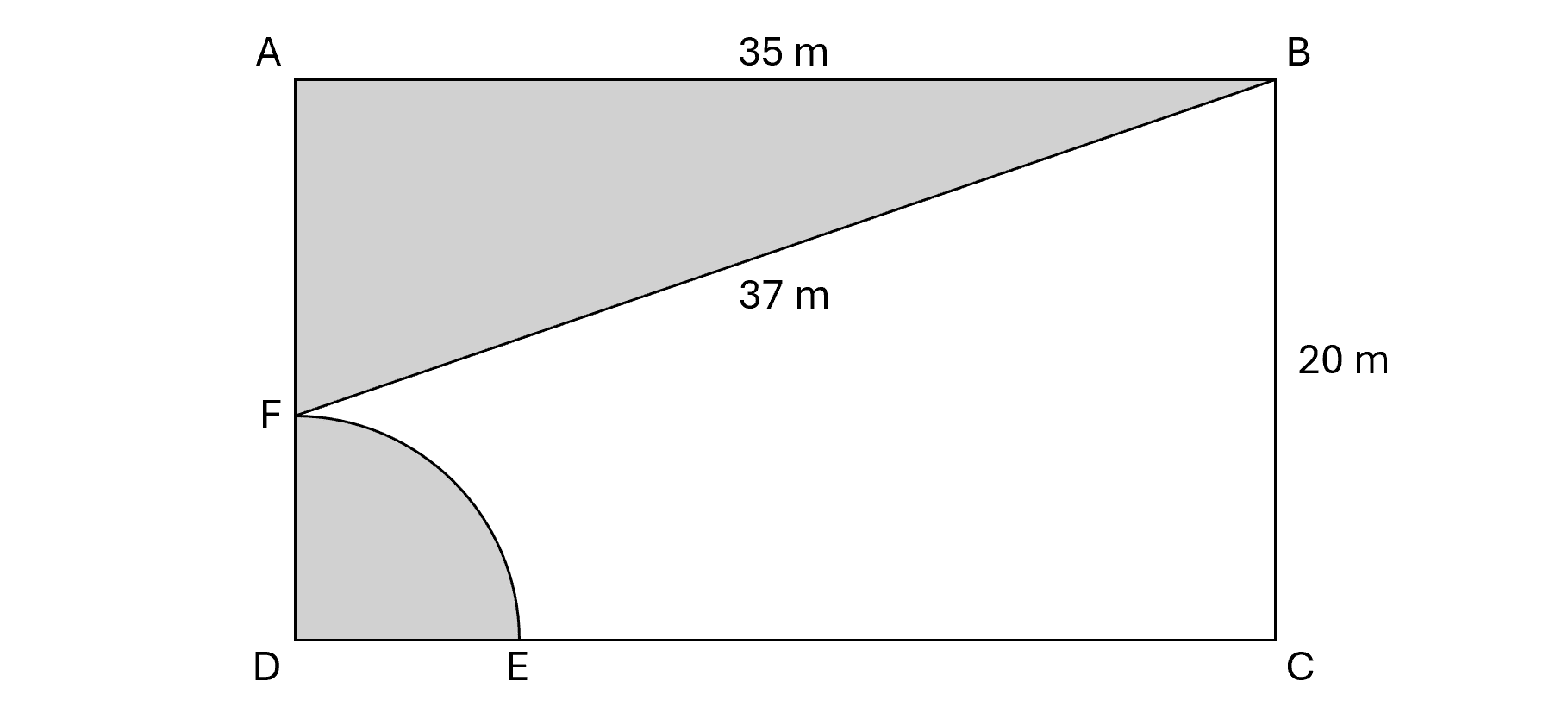
(a) Find the perimeter of the shaded parts.
14 × 2 × 3.14 × 8 = 12.56
35 + 37 + 12.56 + 8 + 20 = 112.56
Ans (a): 112.56 m
(b) Find the area of the shaded parts.
12 × 35 × 12 = 210
14 × 3.14 × 8 × 8 = 50.24
210 + 50.24 = 260.24
Ans (b): 260.24 m²
💡 Explanation for Understanding
A right-angled triangle and a quarter circle were placed inside Rectangle ABCD of dimensions 35 m by 20 m, with the shaded perimeter being 16 m longer than the unshaded perimeter. In part (a), our goal was to find the perimeter of the shaded parts. In part (b), our goal was to calculate the total shaded area.
The main challenge in this question was identifying where the 16 m difference between the shaded and unshaded perimeters comes from. By comparing the shared boundaries of both regions, we can isolate the extra lengths to find the radius of the quarter circle.
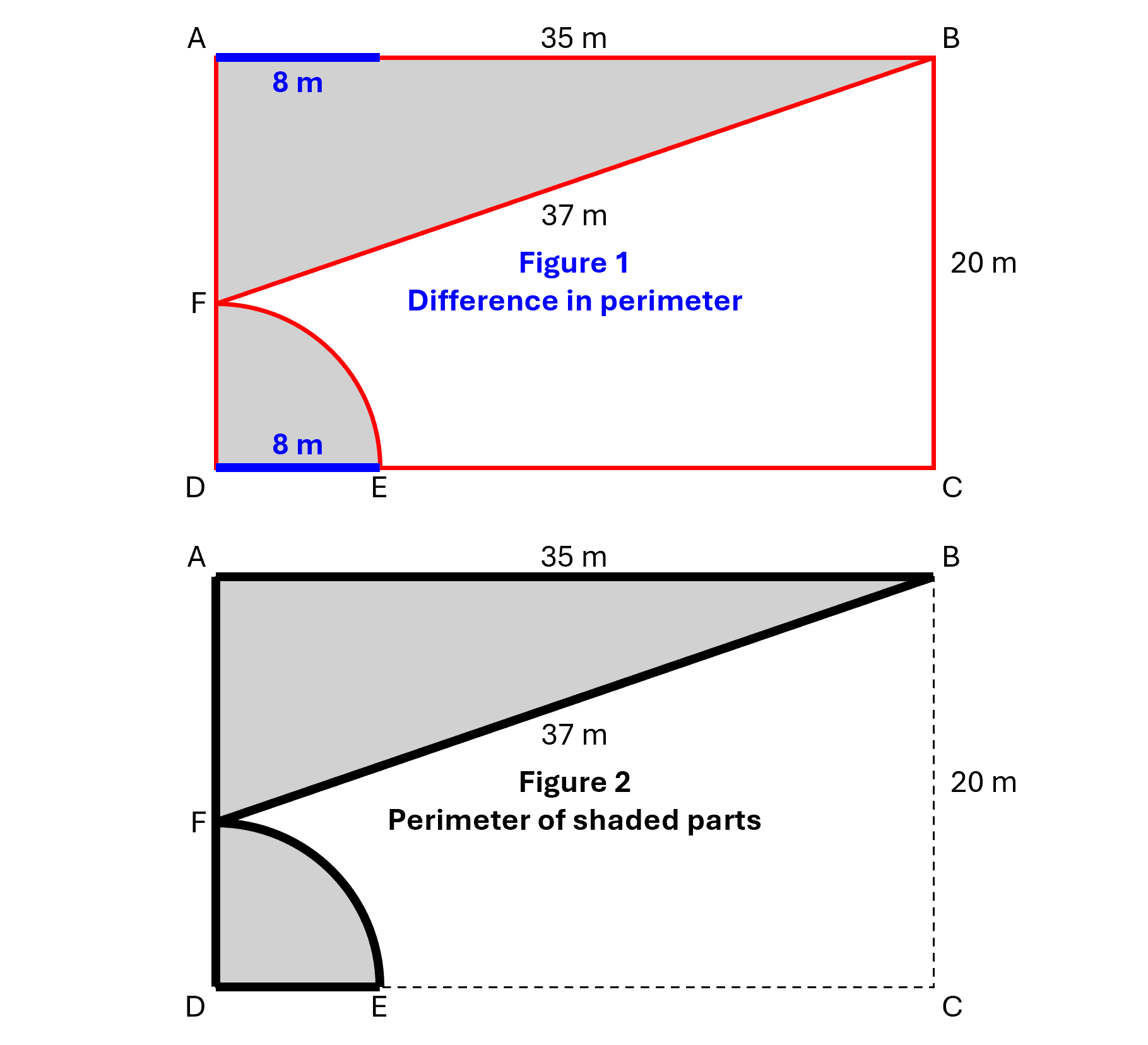
Radius = 16 ÷ 2 = 8 (m).
Quarter circle arc FE = 14 × 2 × 3.14 × 8 = 12.56 (m).
As highlighted in Figure 2, the shaded perimeter consists of:
• Top edge AB = 35 (m)
• Slanted edge BF = 37 (m)
• Arc FE = 12.56 (m)
• Bottom radius DE = 8 (m)
• Left edge AD = 20 (m)
Shaded perimeter = 35 + 37 + 12.56 + 8 + 20 = 112.56 (m).
Since the total height of rectangle AD = 20 m and the radius FD = 8 m:
Height AF = 20 - 8 = 12 (m).
Area of triangle ABF = 12 × base × height = 12 × 35 × 12 = 210 (m²).
Area of quarter circle FDE = 14 × 3.14 × 8 × 8 = 50.24 (m²).
Total shaded area = 210 + 50.24 = 260.24 (m²).
The total cost of a fan and an air purifier before a sale was $510. During the sale, the fan was sold at a 10% discount and the air purifier at a 7% discount. The amount of discount on each item was the same. What was the total cost of the fan and the air purifier during the sale?
Air Purifier discount (7%) : 7 units
Fan discount (10%) : 7 units
Original Fan : 7 × 10 = 70 units
Total original : 100 + 70 = 170 units
1 unit : $510 ÷ 170 = $3
Total cost during sale : 170 - 7 - 7 = 156 units
156 × $3 = $468
Ans: $468
💡 Explanation for Understanding
Two items with a known combined original price have different percentage discounts applied to them, but the actual dollar amount of the discount turns out to be identical. Our objective is to find their new combined price after the sale. The main challenge is finding out how their original prices relate to each other since the discount percentages are different. A common mistake is trying to guess the prices or assuming the original prices were equal and splitting the $510 in half.
Let the original price of the air purifier be 100 units.
Since it had a 7% discount, the discount on the air purifier is 7 units.
The discount on the fan is exactly the same as the air purifier, so the fan's discount is also 7 units.
We know this 7 units represents a 10% discount on the fan.
If 10% is 7 units, then the original price of the fan (100%) is 7 × 10 = 70 units.
Total original price = 100 + 70 = 170 units.
We know the total original cost was $510.
1 unit = $510 ÷ 170 = $3.
We subtract in units the total discount from the original total cost.
Total cost during sale :
170 - 7 - 7 = 156 units.
156 × $3 = $468.
(a) Figure 1 below is formed by overlapping two identical semicircles. O is the mid-point of AB and AB = 8 cm. Find the shaded area in Figure 1. (Take π = 3.14)

2 × 4 × 4 = 32
Ans (a): 32 cm²
(b) Figure 2 below is made up of a large quarter circle, three identical small quarter circles and two identical semicircles. The radius of each small quarter circle is 8 cm. Find the total shaded area in Figure 2. (Take π = 3.14)

50.24 + 32 = 82.24
Ans (b): 82.24 cm²
💡 Explanation for Understanding
This geometry puzzle features a combination of overlapping semicircles and quarter circles forming complex shaded regions. Our objective is to find the area of specific shaded parts by recognizing the relationships between the different shapes.
The main challenge is that calculating the area of the shaded regions directly is far too complex. We can solve this more easily by using the Spatial Rearrangement concept to shift the shaded parts into standard geometric shapes.
Instead of trying to find the area of the awkward curved shapes in Figure 1, we look for identical spaces to move them into.

The total side length across AB is 8 cm, which means the side length of one of our new small squares is 8 ÷ 2 = 4 (cm).
Area of the 2 squares = 2 × 4 × 4 = 32 (cm²).
Our objective is to find the total shaded area in Figure 2. To make this easier, we split the shaded areas into 2 groups as shown below. Shaded Group 1 consists of regions X and Y. Shaded Group 2 is the same as Figure 1 in (a).

Notice that the radius of the large quarter circle is exactly twice the radius of a small quarter circle. Because the area of any circle involves multiplying the radius by itself (radius × radius), doubling the radius makes the total area 2 × 2 = 4 times as large. Therefore, the area of the large quarter circle is exactly 4 times the area of a small quarter circle.
Since there are 3 unshaded small quarter circles within the large quarter circle, when we combine region X and region Y together, they simplify to have the exact same area as one small quarter circle!
Area of Shaded Group 1 (X + Y) = 14 × 3.14 × 8 × 8 = 50.24 (cm²).
Shaded Group 2 is identical to Figure 1 from part (a), which we already calculated is 32 cm².
Total shaded area = 50.24 + 32 = 82.24 (cm²).
Dan spent a total of $660 to buy some apples and pears. He spent $300 more on apples than on pears.
(a) Find the amount of money he spent on apples.
Ans (a): $480
(b) He bought 4 times as many apples as pears. Each pear costs 30 cents more than each apple. Find the cost of an apple.
1 unit of apples : $480 ÷ 4 = $120
Difference for 1 unit : $180 - $120 = $60
Fruits in 1 unit : $60 ÷ $0.30 = 200
Cost of 1 apple : $120 ÷ 200 = $0.60
Ans (b): $0.60
💡 Explanation for Understanding
Dan bought two types of fruits. We are given the total spent, the difference in total spending, the quantity ratio, and the unit price difference. In part (a), our goal is to find the total money spent on apples. In part (b), we need to find the price of a single apple.
The main challenge in part (b) is connecting the total cost of each fruit to their quantity ratio without making things overly complicated. A common mistake is trying to divide the $300 spending difference by the $0.30 price difference, which does not work because the quantities bought are not equal.
Total spending on all fruits = $660.
He spent $300 more on apples than pears.
To find the larger amount (apples) directly, we add the difference to the total and divide by 2.
Amount spent on apples = ($660 + $300) ÷ 2 = $480.
Dan bought 4 times as many apples as pears.
1 unit of pears : $480 - $300 = $180.
4 units of apples : $480.
1 unit of apples : $480 ÷ 4 = $120.
Notice that 1 unit contains the exact same number of fruits for both types.
Yet, 1 unit of pears costs $180 while 1 unit of apples costs $120.
Difference in cost for 1 unit = $180 - $120 = $60.
Why does 1 unit of pears cost $60 more? Because every single pear costs $0.30 more than an apple!
Since each pear creates a $0.30 price gap, we divide the $60 total gap by $0.30 to find the number of fruits inside 1 unit.
Number of fruits in 1 unit = $60 ÷ $0.30 = 200.
Since 1 unit of apples contains 200 apples and costs $120 in total:
Cost of 1 apple = $120 ÷ 200 = $0.60.
Mrs Ang baked a total of 360 cookies and muffins. After she gave away 47 of the muffins and 58 of the cookies, she had a total of 141 cookies and muffins left. How many cookies did Mrs Ang give away?
Cookies left : 1 - 58 = 38 (3 parts)
3 units + 3 parts = 141
1 unit + 1 part = 141 ÷ 3 = 47
7 units + 7 parts = 7 × 47 = 329
Total at first (7 units + 8 parts) = 360
1 part = 360 - 329 = 31
Cookies given away (5 parts) = 5 × 31 = 155
Ans: 155
💡 Explanation for Understanding
Mrs Ang had two different types of baked goods (muffins and cookies) with different fractions given away. Since the starting quantities of muffins and cookies were not equal, we assign units to the muffins and parts to the cookies. Our goal was to find the number of cookies given away using the Units and Parts method.
Muffins given away = 47. So, let total muffins at first = 7 units.
Muffins left = 7 units - 4 units = 3 units.
Cookies given away = 58. So, let total cookies at first = 8 parts.
Cookies left = 8 parts - 5 parts = 3 parts.
Total items left = 3 units + 3 parts = 141.
Dividing the entire equation by 3 gives:
1 unit + 1 part = 141 ÷ 3 = 47.
Multiply (1 unit + 1 part = 47) by 7 to match the 7 units of muffins at first:
7 units + 7 parts = 7 × 47 = 329.
We know the total items at first (7 units + 8 parts) was 360:
7 units + 8 parts = 360
7 units + 7 parts = 329
Comparing the two statements:
1 part = 360 - 329 = 31.
Cookies given away = 5 parts.
Cookies given away = 5 × 31 = 155.
Tank A is a rectangular tank with a square base. Tank A has a volume of 2592 cm³.
The height of tank A is 32 of the length of tank A.
(a) What is the length of tank A?
∛1728 = 12
Ans (a): 12 cm
(b) Tank B is a cubical tank. The length of tank B is twice the length of tank A. Find the volume of tank B.
24 × 24 × 24 = 13 824
Ans (b): 13 824 cm³
💡 Explanation for Understanding
Tank A has a square base, meaning its length and breadth are equal. We were told its height is 32 of its base length. In part (a), our goal was to find the length of Tank A by reducing the height to form a perfect cube. In part (b), our goal was to calculate the volume of a larger cubical Tank B.
Since the height of Tank A is 32 of its base length:
• Length of square base = 2 units
• Breadth of square base = 2 units
• Height of tank = 3 units
If we consider the volume up to a height of 2 units (instead of 3 units), the height becomes equal to the length and breadth (2 units × 2 units × 2 units). This reduced section forms a perfect cube!
 This reduced cubical volume is 23 of Tank A's total volume:
Reduced volume = 23 × 2592 = 1728 (cm³).
Since the reduced volume is a cube with side length equal to Tank A's base length:
Length × Length × Length = 1728 (cm³)
Length of Tank A = ∛1728 = 12 (cm) (since 12 × 12 × 12 = 1728).
Length of Tank B = 2 × Length of Tank A = 2 × 12 = 24 (cm).
Since Tank B is a cubical tank (length = breadth = height = 24 cm):
Volume of Tank B = 24 × 24 × 24 = 13 824 (cm³).
The figure shows a large semicircle and 3 identical small semicircles. The diameter of the large semicircle is 28 cm. (Take π = 227)

(a) Find the area of the large semicircle.
12 × 227 × 14 × 14 = 308
Ans (a): 308 cm²
(b) Find the area of the shaded part.
12 × 227 × 7 × 7 = 77
7 × 7 = 49
308 - 77 - 49 = 182
Ans (b): 182 cm²
💡 Explanation for Understanding
This problem features overlapping circular arcs inside a large semicircle. In part (a), our objective was to find the area of the large semicircle. In part (b), our objective was to find the total shaded area. The key challenge in part (b) was calculating complex overlapping regions. We simplified this using the Spatial Rearrangement Method (shifting a shaded quadrant to reveal clean geometric shapes).
Diameter of large semicircle = 28 cm.
Radius of large semicircle = 28 ÷ 2 = 14 (cm).
Area of large semicircle = 12 × π × r × r
= 12 × 227 × 14 × 14 = 308 (cm²).

1. One small unshaded semicircle (radius = 7 cm).
2. One unshaded square (side length = 7 cm).
Radius of small semicircle = 14 ÷ 2 = 7 (cm).
Area of 1 small semicircle = 12 × 227 × 7 × 7 = 77 (cm²).
Area of unshaded square = 7 × 7 = 49 (cm²).
Subtract the unshaded shapes from the total area of the large semicircle:
Shaded Area = Area of large semicircle - Area of 1 small semicircle - Area of square
= 308 - 77 - 49 = 182 (cm²).
At first, tank A is empty and tank B is completely filled with water.
Water flowed into tank A from tap A at a rate of 2.65 ℓ/min.
Water flowed out of tap B at a rate of 2.75 ℓ/min.

(a) What is the rate of increase in the height of the water level in tank A in cm per minute?
2.65 ℓ = 2650 cm³
2650 ÷ 500 = 5.3
Ans (a): 5.3 cm/min
(b) What is the rate of decrease in the height of water level in tank B in cm per minute?
2.75 ℓ = 2750 cm³
2750 ÷ 1250 = 2.2
Ans (b): 2.2 cm/min
(c) Both taps are turned on at the same time. After some time, the height of the water level in tank A was the same as that in tank B. How long does it take for the height of the water level to be the same in both tank A and tank B? Find the height of the water level when it is the same in both tank A and tank B.
30 ÷ 7.5 = 4
4 × 5.3 = 21.2
Ans (c): Time = 4 min, Height = 21.2 cm
💡 Explanation for Understanding
Tank A receives water to increase its height while Tank B drains water to decrease its height. In parts (a) and (b), our objective was to convert flow rate in liters to rate of height change using base area. In part (c), our objective was to find when both water levels meet and calculate that shared height.
Base area of Tank A = length × breadth = 20 × 25 = 500 (cm²).
Flow rate into Tank A = 2.65 (ℓ/min) = 2650 (cm³/min).
Rate of height increase = 2650 ÷ 500 = 5.3 (cm/min).
Base area of Tank B = length × breadth = 50 × 25 = 1250 (cm²).
Flow rate out of Tank B = 2.75 (ℓ/min) = 2750 (cm³/min).
Rate of height decrease = 2750 ÷ 1250 = 2.2 (cm/min).
At first, water height in Tank A = 0 (cm).
At first, water height in Tank B = 30 (cm).
Initial difference in water height = 30 - 0 = 30 (cm).
Since Tank A's water level is rising by 5.3 cm/min and Tank B's water level is falling by 2.2 cm/min, the height gap closes at a combined rate of:
Combined rate = 5.3 + 2.2 = 7.5 (cm/min).
Time taken to meet = 30 ÷ 7.5 = 4 (min).
Height of water level in Tank A after 4 minutes:
Height = 4 × 5.3 = 21.2 (cm).
The Green Club collected 960 bottles in February. This was an increase of 60% from January. In March, the number of bottles collected decreased by 25% from February. What was the percentage increase in the number of bottles collected in March compared to January?
March : 75% × 160% of Jan = 120% of Jan
Increase from Jan : 120% - 100% = 20%
Ans: 20%
💡 Explanation for Understanding
We were asked to find the percentage increase in the number of bottles collected in March compared to January. Although the question provides the actual number of bottles collected in February (960 bottles), we do not need to use this numerical value. Since the final question asks for a relative percentage change, we can solve it directly by treating January as the base value of 100%.
February's collection was a 60% increase from January.
February = 100% + 60% = 160% of January.
March experienced a 25% decrease from February, so March was 75% (100% - 25%) of February's collection.
March = 75% × 160% of January = 120% of January.
Comparing March (120%) directly to January (100%):
Percentage increase = 120% - 100% = 20%.
5 players booked a tennis court and took turns to play on the court. At any time, there were 4 players playing on the court. Each player played for 144 minutes. How long did they book the tennis court for?
720 ÷ 4 = 180
180 ÷ 60 = 3
Ans: 3 h
💡 Explanation for Understanding
5 players shared a tennis court where exactly 4 players played simultaneously at any given moment. Given that each player accumulated 144 minutes of playing time, our goal was to calculate the total duration of the court booking.
Since 5 players played for 144 minutes each, the total time spent by all players combined was 5 × 144 = 720 (player-minutes).
Because exactly 4 players were active on the court at any point during the booking, every court-minute corresponded to 4 player-minutes.
Court-minutes = 720 ÷ 4 = 180
Booking duration in hours: 180 min = 3 h
Mrs Menon baked some cookies. She packed 35 of the cookies equally into 6 large tins and 14 of the remaining cookies equally into 4 small tins. The rest of the cookies were given away.
(a) What fraction of the cookies was given away?
4 small tins : 14 × 25 = 110
Given away : 25 - 110 = 310
Ans (a): 310
(b) There are 176 cookies in 2 large tins and 3 small tins. How many cookies did Mrs Menon bake?
3 small tins : 34 × 110 = 340
2 large tins + 3 small tins : 15 + 340 = 1140
Total cookies baked : 176 ÷ 11 × 40 = 640
Ans (b): 640
💡 Explanation for Understanding
Mrs Menon packed her cookies into 6 large tins, 4 small tins, and gave away the rest. In part (a), our objective was to find the fraction of total cookies given away by sequentially subtracting each fraction from the total. In part (b), our objective was to determine the total cookies baked by converting 2 large tins and 3 small tins into their equivalent fractions of the total batch.
She packed 35 of her cookies into large tins.
Fraction remaining = 1 - 35 = 25.
She packed 14 of the remaining cookies into small tins.
Fraction for small tins = 14 of 25 = 14 × 25 = 110 of total cookies.
Subtract the small tins' fraction from the remaining fraction:
Fraction given away = 25 - 110 = 310.
Since 6 large tins contain 35 of total cookies, 2 large tins represent 26 (or 13) of that portion.
Fraction for 2 large tins = 26 × 35 = 15 of total cookies.
Since 4 small tins contain 110 of total cookies, 3 small tins represent 34 of that portion.
Fraction for 3 small tins = 34 × 110 = 340 of total cookies.
Combined fraction = 15 + 340 = 1140.
We know that 1140 of the total cookies equal 176 cookies.
11 units = 176
Total cookies baked (40 units) = 176 ÷ 11 × 40 = 640 cookies.
The shaded figure is formed by 4 identical quarter circles inside a rectangle. (Take π = 3.14)
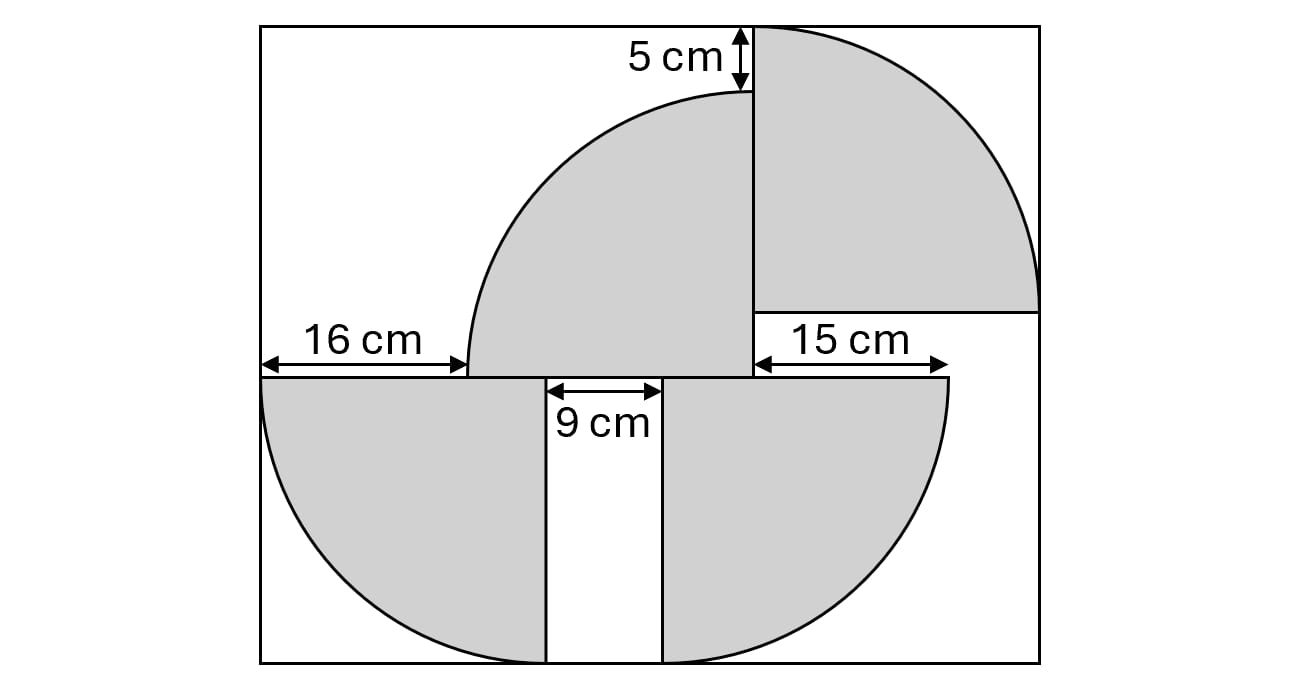
(a) Find the radius of each quarter circle.
Ans (a): 22 cm
(b) Find the perimeter of the shaded figure.
138.16 + 3 × 22 + 16 + 9 + 15 + 5 + 5 = 254.16
Ans (b): 254.16 cm
(c) Find the unshaded area of the rectangle.
2 × 22 + 5 = 49
60 × 49 = 2940
3.14 × 22 × 22 = 1519.76
2940 - 1519.76 = 1420.24
Ans (c): 1420.24 cm²
💡 Explanation for Understanding
This spatial puzzle required us to deduce the dimensions of the quadrants and the bounding rectangle from a set of overlapping horizontal and vertical gaps. The main challenge is how best to make sense of the length comparisons.
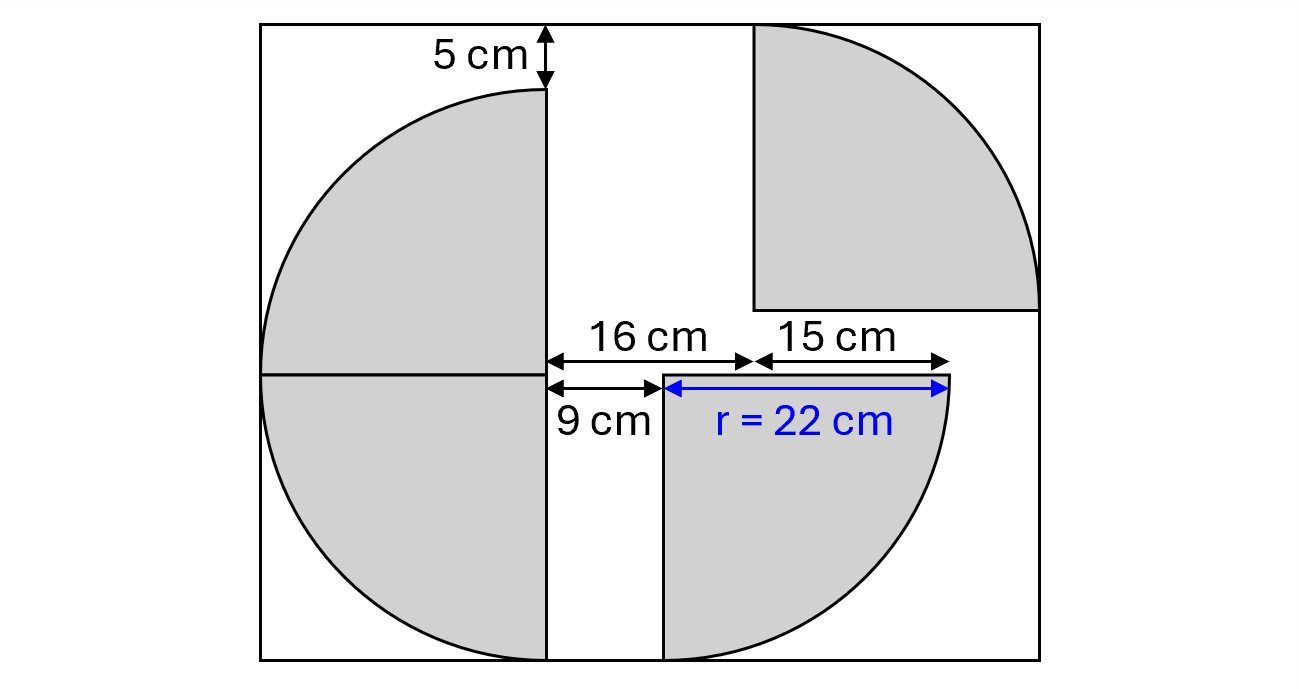
As seen in the diagram, r + 9 = 16 + 15, so the radius r is simply
31 - 9 = 22 (cm).
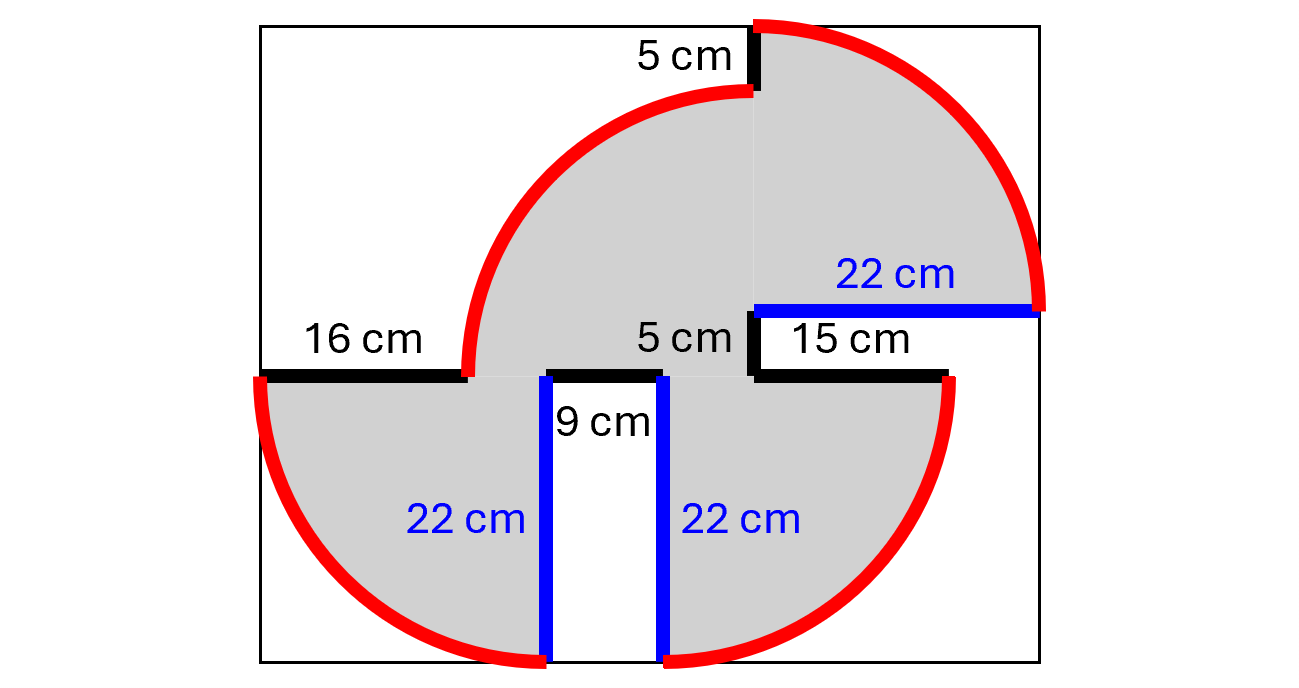
• Red - 4 quadrant arcs (1 circumference): 3.14 × 2 × 22 = 138.16 (cm).
• Blue - 3 radii: 3 × 22 = 66 (cm).
• Black - 5 given lines: 16 + 9 + 15 + 5 + 5 = 50 (cm).
Total Perimeter = 138.16 + 66 + 50 = 254.16 cm.
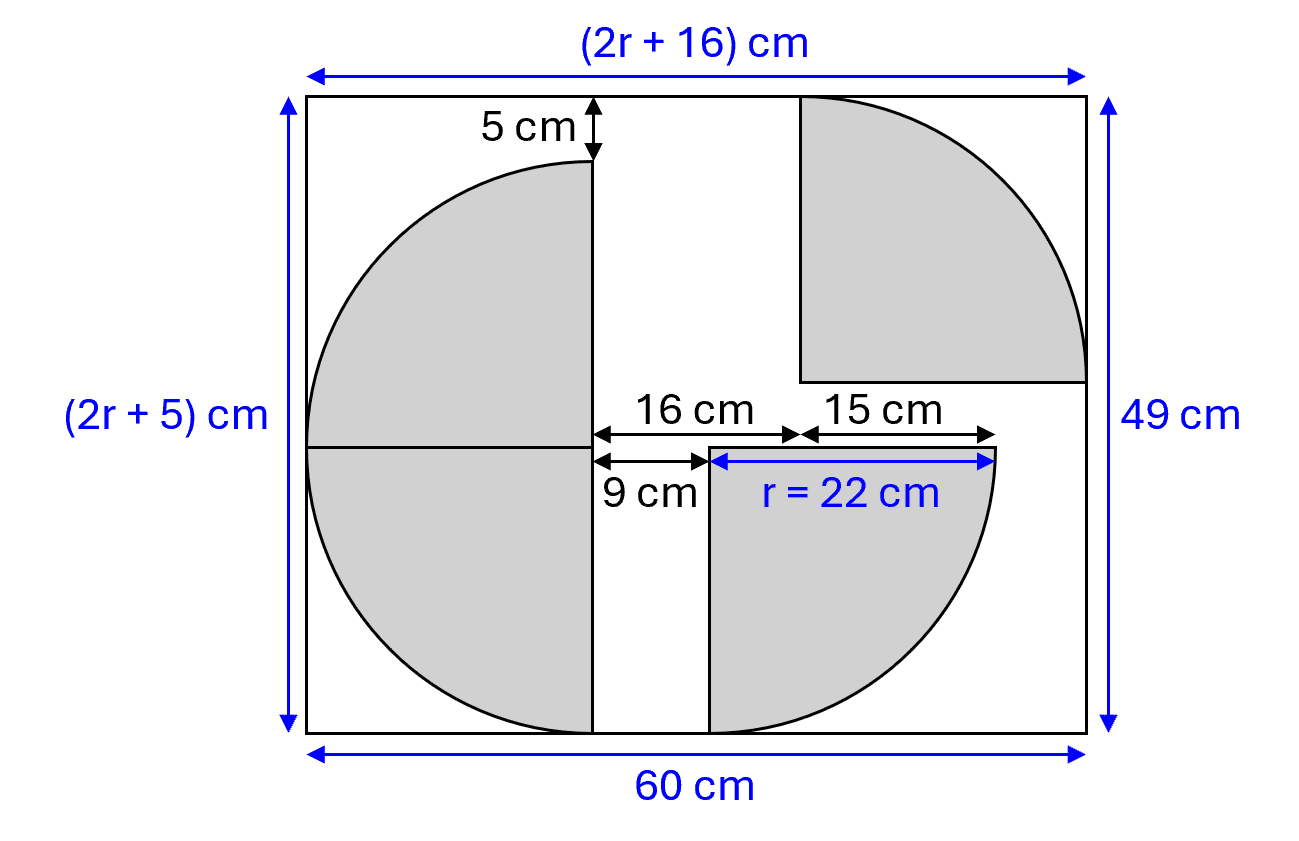
Length = 2r + 16 = 2(22) + 16 = 60 cm.
Breadth = 2r + 5 = 2(22) + 5 = 49 cm.
Unshaded Area = Area of rectangle - Area of 1 circle
= (60 × 49) - (3.14 × 22 × 22)
= 1420.24 cm².
Ahmad had a rectangular block of wood as shown in Figure 1. The length of the rectangular block is 4 cm and the breadth is 5 cm. He cut out a cube from the block and painted all the faces of the remaining block white as shown in Figure 2. The volume of the cube removed is 27 cm³.
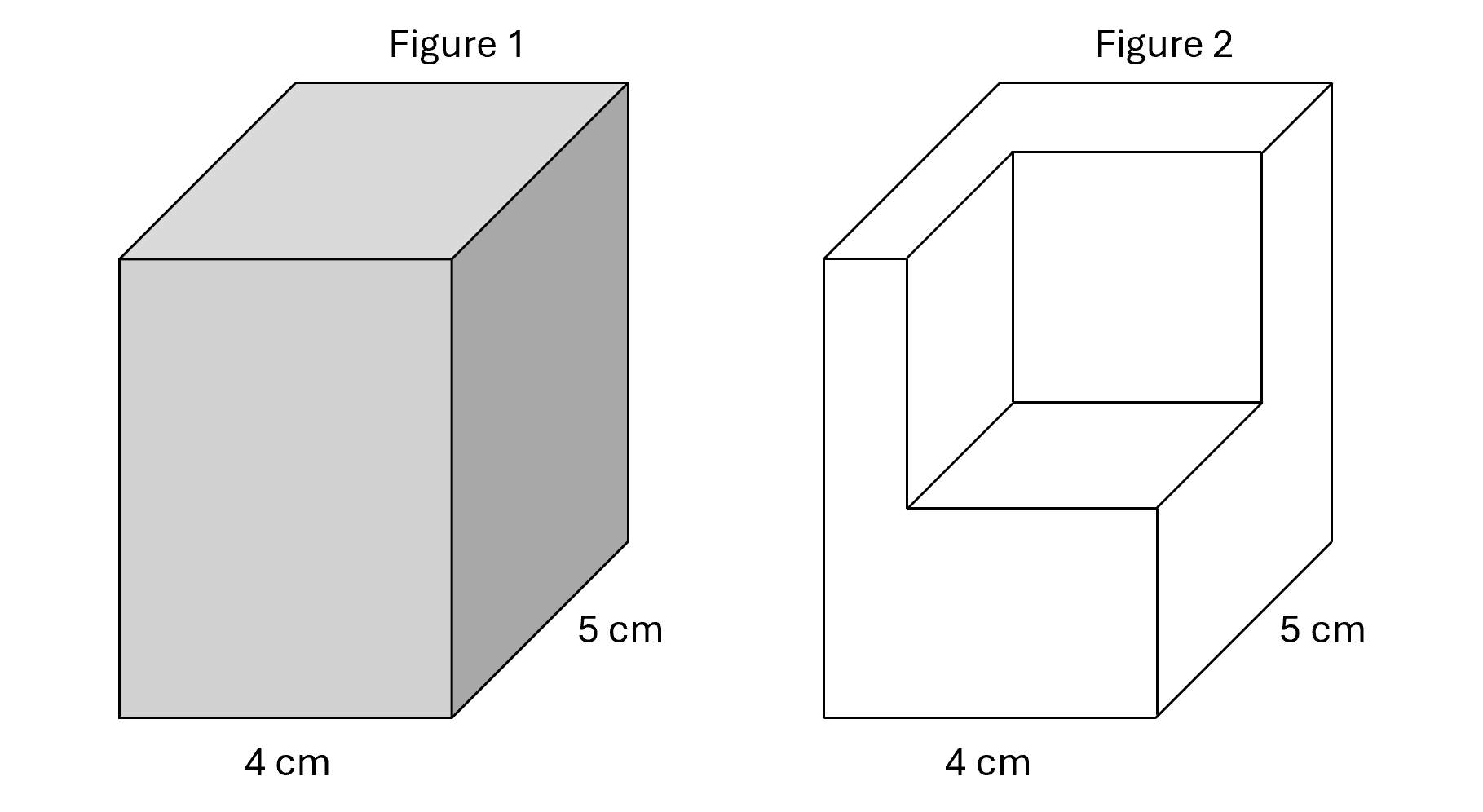
(a) Find the length of the cube removed.
Ans (a): 3 cm
(b) The volume of the remaining block in Figure 2 is 73 cm³. Find the height of the rectangular block in Figure 1.
4 × 5 = 20
100 ÷ 20 = 5
Ans (b): 5 cm
(c) Ahmad cut the remaining block in Figure 2 into 1-cm cubes. How many of these cubes have 3 of the faces painted white?
Ans (c): 12
💡 Explanation for Understanding
Ahmad starts with a solid rectangular block of wood, cuts out a cube from one corner, and paints every exposed surface of the remaining block white. Our goals are to find the length of the removed cube, the original height of the block, and the exact number of 1-cm cubes that have exactly 3 painted faces.
The main challenge is visualizing the newly exposed inner faces created by the cutout. A very common mistake is assuming that only the original outer corners have 3 painted faces, missing the fact that the cut exposes additional faces on the cubes bordering the cutout.
The volume of the removed cube is 27 (cm³). Since a cube has equal sides, we find the cube root of the volume.
Length = ∛27 = 3 (cm).
Add the removed volume back to the remaining volume to get the total original volume.
Total volume = 73 + 27 = 100 (cm³).
The base area of the original block is 4 × 5 = 20 (cm²).
Height = Volume ÷ Base Area = 100 ÷ 20 = 5 (cm).
A standard rectangular block has 8 corners, and normally, only these 8 corners have 3 painted faces. When the 3 cm by 3 cm by 3 cm cube is removed from one corner, 1 original corner is completely gone, leaving exactly 7 original corners intact.
However, the cut exposes new faces on the surrounding cubes. Play around with the 3D model below to see exactly where the painted faces end up!
🕹️ Interactive 3D Painted Cubes Visualization
Look at the Red cube in the 3D model. This cube is one of the original corners. Before the cut, it had 3 painted faces (Top, Left, Front). But because the cut slices right next to it, its right side is now exposed and painted too! This means it actually has 4 painted faces, so it is disqualified and not counted.
This leaves us with 6 original corners that still have exactly 3 painted faces.
The cut creates new facees along the inside of the original block. As highlighted in Yellow in the 3D model, there are 6 cubes along the edges of the cut that now have exactly 3 painted faces (two original outer faces plus one newly exposed inner face).
Total cubes with exactly 3 painted faces = 6 (original corners) + 6 (new border cubes) = 12.
Pens and notebooks were sold in bundles in a bookshop: 3 pens for $4.90; 4 notebooks for $5.90.
(a) Daniel bought an equal number of pens and notebooks. He spent $9.50 more on the pens. How many pens did he buy in all?
Cost of 12 pens (4 bundles) : 4 × $4.90 = $19.60
Cost of 12 notebooks (3 bundles) : 3 × $5.90 = $17.70
Difference in cost per 12 items : $19.60 - $17.70 = $1.90
Number of sets of 12 items : $9.50 ÷ $1.90 = 5
Total pens bought : 5 × 12 = 60
Ans (a): 60
(b) Eunice bought some pens and notebooks. The ratio of the total number of pens she bought to the total number of notebooks she bought was 1 : 2. Write down one possible set of the number of bundles of pens and notebooks she bought.
1 bundle of pens : 3 pens
1 bundle of notebooks : 4 notebooks
Try 2 bundles of pens : 2 × 3 = 6 pens
To get 1 : 2 ratio, notebooks needed : 6 × 2 = 12
Bundles of notebooks : 12 ÷ 4 = 3 bundles
Check ratio : 6 pens : 12 notebooks = 1 : 2
Ans (b): Number of bundles of pens: 2
Number of bundles of notebooks: 3
💡 Explanation for Understanding
A bookshop sold pens in bundles of 3 and notebooks in bundles of 4 at different prices. In part (a), Daniel bought an equal number of both items and spent $9.50 more on pens. In part (b), Eunice bought bundles such that her final item count ratio of pens to notebooks was 1 : 2. The main challenge in part (a) was comparing two items that were sold in different bundle sizes. A common mistake was subtracting $4.90 from $5.90 directly, forgetting that 3 pens were being compared to 4 notebooks instead of equal quantities. In part (b), students often confused the ratio of individual items with the ratio of bundles. To make a fair comparison, we used the Grouping concept.
Since Daniel bought an equal number of pens and notebooks, we found the lowest common multiple (LCM) of 3 and 4, which was 12. We could then group them into equal sets of 12 pens and 12 notebooks.
Cost of 12 pens (4 bundles of 3 pens) = 4 × $4.90 = $19.60.
Cost of 12 notebooks (3 bundles of 4 notebooks) = 3 × $5.90 = $17.70.
Inside 1 set of 12 items each, the pens cost $19.60 - $17.70 = $1.90 more than the notebooks.
The total cost difference was $9.50. We divided by $1.90 to find how many sets Daniel bought.
$9.50 ÷ $1.90 = 5 sets.
Since each set contained 12 pens: 5 × 12 = 60 pens.
Eunice needed the ratio of individual pens to notebooks to be 1 : 2.
1 bundle of pens contained 3 pens. To get twice as many notebooks (6 notebooks), we checked if 6 notebooks could be bought in complete bundles of 4. Since 6 was not divisible by 4, we tried 2 bundles of pens.
Number of pens in 2 bundles = 2 × 3 = 6 pens.
Number of notebooks needed = 6 × 2 = 12 notebooks.
Number of notebook bundles needed = 12 ÷ 4 = 3 bundles.
So one possible valid answer was 2 bundles of pens and 3 bundles of notebooks.
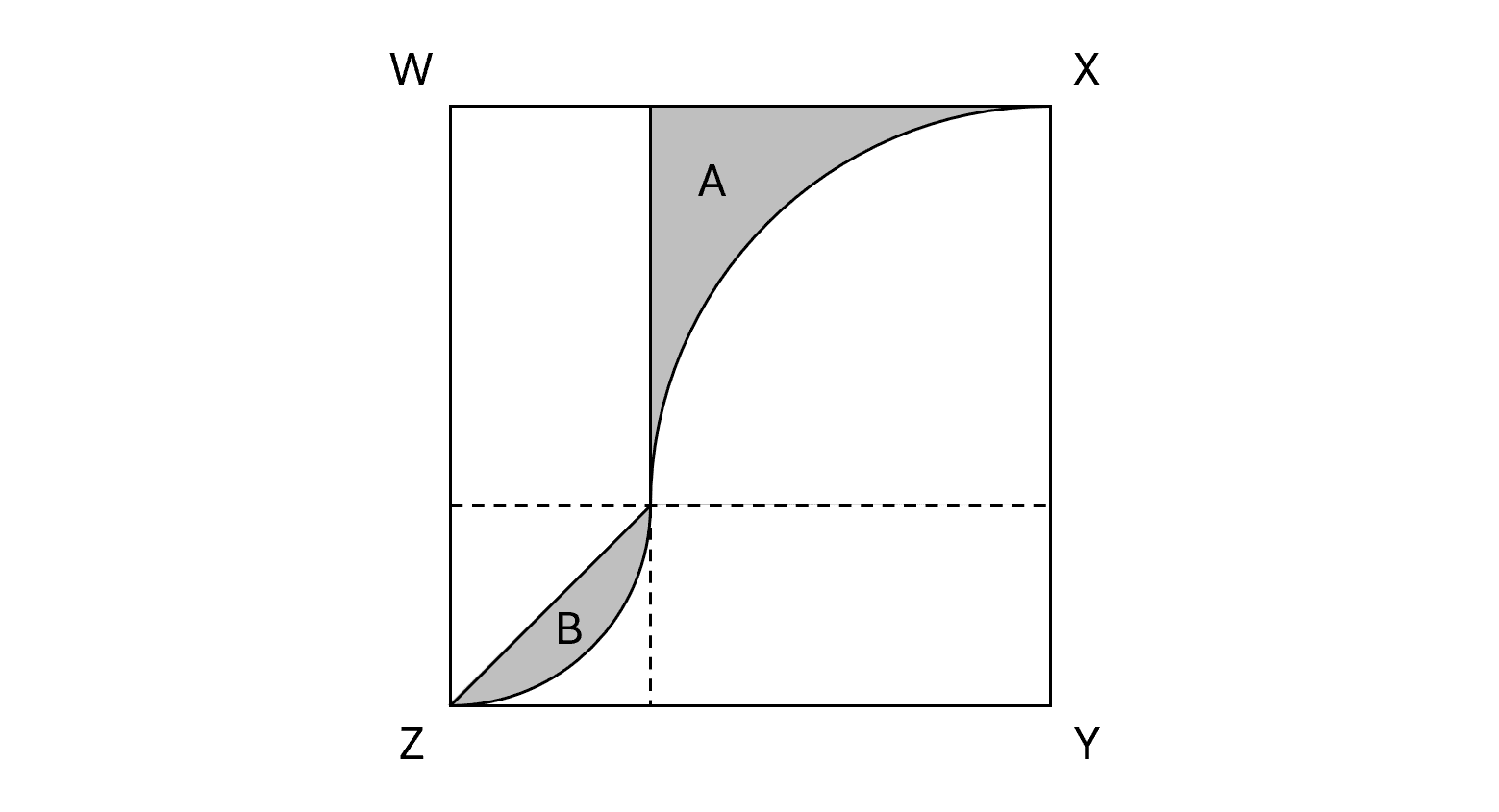
In the square WXYZ, there is a big quadrant and a small quadrant.
The radius of the big quadrant is twice the radius of the small quadrant.
Claire shaded part A and B. The total perimeter of the unshaded parts is 32 cm longer than the total perimeter of the shaded parts. (Take π = 3.14)
(a) Find the perimeter of the shaded part A.
8 units : 32
1 unit : 32 ÷ 8 = 4
Radius of big quadrant : 2 × 4 = 8
Big arc : 14 × 2 × 3.14 × 8 = 12.56
Perimeter of A : 12.56 + 8 + 8 = 28.56
Ans (a): 28.56 cm
(b) Find the total area of the shaded parts.
Area of B : (14 × 3.14 × 4 × 4) - (12 × 4 × 4) = 12.56 - 8 = 4.56
Total shaded area : 13.76 + 4.56 = 18.32
Ans (b): 18.32 cm²
💡 Explanation for Understanding
Square WXYZ contained two quadrants of different sizes, with two shaded regions A and B. We were given that the total perimeter of the unshaded parts was 32 cm longer than the total perimeter of the shaded parts. Our goals were to find the perimeter of shaded part A, and the total area of both shaded parts. The main challenge was comparing the perimeters of complex curved shapes without knowing the actual dimensions first. A common mistake was trying to write long algebraic perimeter equations for every single curve, without realizing that all the curved arcs appeared in both the shaded and unshaded perimeters and completely canceled each other out.
Since the radius of the big quadrant was twice the radius of the small quadrant, let the small quadrant radius be 1 unit. The big quadrant radius was 2 units, making the total side length of square WXYZ equal to 3 units. We could divide the entire figure into a 3 by 3 grid of 1-unit squares.
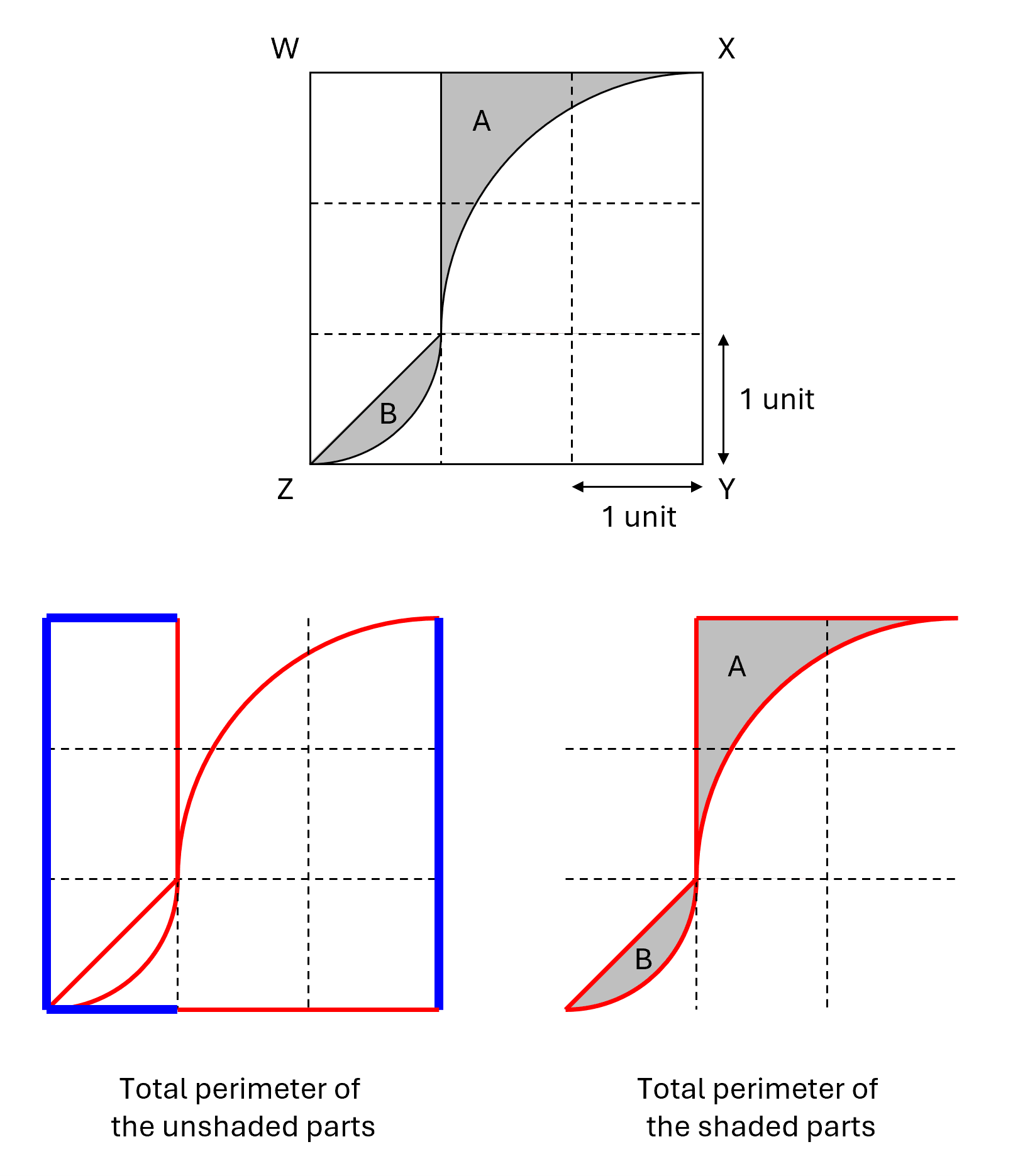
We traced all the boundary lines for both sets of regions:
The red lines in the diagram represent shared boundaries (both curved arcs and straight inner lines) that existed in both the shaded and unshaded perimeters. Because these red lines were identical in length for both sets, they canceled each other out completely when finding the difference!
The blue lines represent the extra outer straight edges that belonged exclusively to the unshaded perimeter. By counting these blue outer edges, the unshaded perimeter exceeded the shaded perimeter by exactly 8 grid units.
8 units = 32 cm.
1 unit = 32 ÷ 8 = 4 cm.
Part A was bounded by a top straight edge of 2 units (8 cm), a left straight edge of 2 units (8 cm), and the big arc.
Radius of big quadrant = 2 units = 8 cm.
Big arc = 14 × 2 × 3.14 × 8 = 12.56 (cm).
Perimeter of A = 12.56 + 8 + 8 = 28.56 (cm).
Part A was the remaining area of a 2-unit by 2-unit square (8 cm by 8 cm) after removing the big quadrant.
Area of 8 cm square = 8 × 8 = 64 (cm²).
Area of big quadrant = 14 × 3.14 × 8 × 8 = 50.24 (cm²).
Area of A = 64 - 50.24 = 13.76 (cm²).
Part B was formed by taking a small quadrant (radius 4 cm) and subtracting half of the small 4 cm by 4 cm square (a triangle).
Area of small quadrant = 14 × 3.14 × 4 × 4 = 12.56 (cm²).
Area of half the small square (triangle) = 12 × 4 × 4 = 8 (cm²).
Area of B = 12.56 - 8 = 4.56 (cm²).
Total shaded area = Area of A + Area of B.
13.76 + 4.56 = 18.32 (cm²).
Mrs Lee baked some tarts. She kept 55 of them for her family and gave 25 of the remaining tarts to her neighbours.
She was left with 27 of the tarts she baked and she packed all of them into 12 boxes. Some boxes contained 2 tarts each while the rest contained 4 tarts each.
(a) What fraction of the tarts she baked was kept for her family?
35 of remainder : 27 of total
Total remaining fraction : 27 ÷ 3 × 5 = 1021
Family fraction : 1 - 1021 = 1121
Ans (a): 1121
(b) How many boxes contained 2 tarts?
1 part : 55 ÷ 11 = 5
Total tarts : 21 × 5 = 105
Leftover tarts : 27 × 105 = 30
Assume all 12 boxes contained 4 tarts :
Total assumed tarts : 12 × 4 = 48
Difference : 48 - 30 = 18
Difference per box : 4 - 2 = 2
Boxes with 2 tarts : 18 ÷ 2 = 9
Ans (b): 9
💡 Explanation for Understanding
Mrs Lee baked tarts, kept 55 for her family, gave away a fraction of the remainder, and packed the rest into 12 boxes containing 2 or 4 tarts each. Our objective in part (a) was to find what fraction of the total baked tarts was kept for the family. In part (b), we needed to determine how many boxes held 2 tarts. The main challenge in part (a) was managing two different wholes: the fraction given to neighbours was based on the remaining tarts, whereas the final leftover fraction was based on the total baked tarts. A common mistake was subtracting fractions without converting them to a common whole. In part (b), once the total leftover tarts were calculated, we applied the Supposition concept to solve the box packing problem cleanly.
She gave away 25 of the remaining tarts to neighbours, leaving her with 1 - 25 = 35 of the remainder.
We were told these leftover tarts represented 27 of the total baked tarts.
So, 35 of the remainder = 27 of the total.
To find the full remainder as a fraction of total baked tarts, we divided by 3 and multiplied by 5.
27 ÷ 3 × 5 = 1021 of the total baked tarts.
The total baked tarts represented 1 whole (2121). Since the remainder was 1021, the family's share was:
1 - 1021 = 1121.
From part (a), 1121 of total tarts = 55 tarts.
1 part = 55 ÷ 11 = 5 tarts.
Total tarts baked = 21 × 5 = 105 tarts.
Leftover tarts packed into boxes = 27 × 105 = 30 tarts.
We assumed all 12 boxes contained 4 tarts each:
12 × 4 = 48 tarts.
Extra tarts counted = 48 - 30 = 18 tarts.
Replacing one 4-tart box with a 2-tart box reduced the total by 4 - 2 = 2 tarts.
Number of 2-tart boxes = 18 ÷ 2 = 9 boxes.
The sum of two different 2-digit numbers, A and B, is 63.
These two numbers have exactly 2 common factors other than 1.
Number A has exactly 4 factors.
Find the difference between Number A and Number B.
A (4 factors: 1, 3, 9, 27) : 3 × 9 = 27
B : 63 - 27 = 36
Difference : 36 - 27 = 9
Ans: 9
💡 Explanation for Understanding
Two 2-digit numbers A and B add up to 63, share exactly 2 common factors other than 1, and Number A has exactly 4 factors. Our goal was to find the difference between Number A and Number B. The main challenge in this question is recognizing that "2 common factors other than 1" means a total of 3 common factors, which implies their Highest Common Factor (HCF) must be a perfect square that also divides their sum of 63.
Having 2 common factors other than 1 means A and B share a total of 3 common factors (1 plus 2 other factors).
Since the total number of common factors is an odd number (3 factors), their HCF must be a perfect square.
The HCF of A and B must also be a factor of their sum (63).
The factors of 63 are 1, 3, 7, 9, 21, and 63.
The only perfect square factor of 63 (other than 1) is 9.
Therefore, the HCF of A and B is 9, and their common factors are 1, 3, and 9.
We are given that A has exactly 4 factors. Since 1, 3, and 9 are already 3 of its factors, the 4th factor must be A itself.
Expressing A as factor pairs:
A = 1 × A = 3 × 9
Thus, A = 27.
Since A + B = 63:
B = 63 - 27 = 36.
Difference = 36 - 27 = 9.
On Tuesday, Kai Li spent 27 of her money on 10 magnets and 16 postcards in a souvenir shop. On Wednesday, she spent 45 of her remaining money on more magnets and postcards. She bought 2 times as many magnets as postcards on Wednesday. The cost of each magnet was 5 times the cost of each postcard. How many magnets did Kai Li buy altogether?
Cost of 1 magnet = 5
Tuesday spending (27) : 10(5) + 16(1) = 66
Remaining money (57) : 66 ÷ 2 × 5 = 165
Wednesday spending : 45 × 165 = 132
Cost of 1 set (2 magnets + 1 postcard) : 2(5) + 1(1) = 11
Sets bought on Wednesday : 132 ÷ 11 = 12
Wednesday magnets : 12 × 2 = 24
Total magnets : 10 + 24 = 34
Ans: 34
💡 Explanation for Understanding
Kai Li spent fractions of her money buying magnets and postcards over Tuesday and Wednesday. In this question, our goal was to calculate the total number of magnets she bought altogether. The main challenge lies in navigating proportional purchases across two days when no actual monetary values are given. We resolve this easily by assuming a base unit cost of $1 for each postcard.
Let the cost of 1 postcard = 1 ($).
Cost of 1 magnet = 5 × 1 = 5 ($).
Tuesday spending = 10 magnets + 16 postcards
Tuesday spending = (10 × 5) + (16 × 1) = 50 + 16 = 66 ($).
Since Tuesday's spending represents 27 of her total money:
27 of money = 66 ($).
17 of money = 66 ÷ 2 = 33 ($).
Remaining money (57) = 5 × 33 = 165 ($).
Wednesday spending = 45 of remaining money = 45 × 165 = 132 ($).
On Wednesday, she bought 2 magnets for every 1 postcard (1 set = 2 magnets + 1 postcard).
Cost of 1 set = (2 × 5) + (1 × 1) = 10 + 1 = 11 ($).
Number of sets bought = 132 ÷ 11 = 12 (sets).
Magnets bought on Wednesday = 12 × 2 = 24 (magnets).
Total magnets = 10 (Tuesday) + 24 (Wednesday) = 34 (magnets).
Pomon cards are sold in packets of 5. Each packet may contain gold cards, silver cards, or a mix of both.
Ben and Danny bought the same number of packets of cards. Caleb bought 2 more packets of cards than Ben.
The 3 boys each received a mix of gold and silver cards. Ben had 14 silver cards while Danny had 8 silver cards. Caleb had 19 silver cards.
(a) How many more gold cards did Danny receive than Ben?
Ans (a): 6
(b) The cards can be exchanged for points. Each gold card is worth 7 points. Each silver card is worth 2 points. Ben and Danny used all their cards and exchanged them for points. How many more points did Danny exchange than Ben?
6 × 5 = 30
Ans (b): 30
(c) Danny used all his points to redeem a prize. Caleb used only the points from his gold cards to redeem another prize. The two prizes cost 527 points altogether. How many packets of Pomon cards did Caleb buy?
Gold points : 527 - 16 = 511
Combined gold cards : 511 ÷ 7 = 73
Caleb vs Danny
Extra silver : 19 - 8 = 11
Extra total : 2 × 5 = 10
Fewer gold : 11 - 10 = 1
Caleb
Gold cards : (73 - 1) ÷ 2 = 36
Total cards : 36 + 19 = 55
Packets : 55 ÷ 5 = 11
Ans (c): 11
💡 Explanation for Understanding
Three boys bought packets of 5 cards (gold or silver) with given silver card counts and point values. In part (a), our goal was to find how many more gold cards Danny had than Ben. In part (b), we calculated the difference in points between Danny and Ben. In part (c), we determined the total packets Caleb bought using combined prize points. The main challenge in part (c) is finding Caleb's total packets without using algebra by analyzing card differences step-by-step.
Danny and Ben bought the exact same number of packets, so they have the exact same total number of cards.
Danny received 8 silver cards while Ben received 14 silver cards (Danny has 6 fewer silver cards).
Therefore, Danny must have 6 more gold cards than Ben.
Difference = 14 - 8 = 6 (cards).
Each gold card is worth 7 points and each silver card is worth 2 points.
Difference in value between 1 gold card and 1 silver card = 7 - 2 = 5 (points).
Since Danny has 6 more gold cards and 6 fewer silver cards than Ben, there are 6 such swap pairs.
Net extra points for Danny = 6 × 5 = 30 (points).
Danny used points from all his cards (gold + 8 silver cards).
Caleb used points only from his gold cards.
Danny's 8 silver cards contributed = 8 × 2 = 16 (points).
Points generated strictly by Danny's and Caleb's gold cards combined = 527 - 16 = 511 (points).
Combined number of gold cards = 511 ÷ 7 = 73 (gold cards).
• Caleb bought 2 more packets than Danny, which means he has 2 × 5 = 10 more total cards than Danny.
• Caleb has 19 silver cards while Danny has 8 silver cards, so Caleb has 19 - 8 = 11 more silver cards than Danny.
Since Caleb has 11 more silver cards but only 10 more total cards, Caleb must have 11 - 10 = 1 fewer gold card than Danny!
Danny gold cards + Caleb gold cards = 73.
Since Caleb has 1 fewer gold card than Danny:
Caleb gold cards = (73 - 1) ÷ 2 = 36 (gold cards).
Caleb total cards = 36 gold cards + 19 silver cards = 55 (cards).
Total packets bought by Caleb = 55 ÷ 5 = 11 (packets).
A rectangular container and cuboid X, not drawn to scale, are shown below.
What is the greatest number of cuboid X that can be packed into the rectangular container?

Length : 66 ÷ 6 = 11
Breadth : 24 ÷ 4 = 6
Height : 50 ÷ 5 = 10
Subtotal : 11 × 6 × 10 = 660
Section 2 (4 × 24 × 50) :
Length : 4 ÷ 4 = 1
Breadth : 24 ÷ 6 = 4
Height : 50 ÷ 5 = 10
Subtotal : 1 × 4 × 10 = 40
Total cuboids : 660 + 40 = 700
Ans: 700
💡 Explanation for Understanding
We were asked to find the maximum number of cuboids (measuring 5 cm by 4 cm by 6 cm) that could be packed into a large container measuring 70 cm by 24 cm by 50 cm.
The main challenge was realizing that cuboids do not all have to be placed in a single uniform orientation. By splitting the container into two sections with mixed orientations, we could utilize 100% of the container's volume with zero wasted space.
A common mistake students make in such problems is simply dividing the container's total volume by the volume of a single cuboid. Although that shortcut happened to yield the same numerical answer in this specific problem, relying on pure volume division is conceptually flawed because it fails to treat the container and cuboids as rigid physical objects with fixed dimensions.
Volume of Container = 70 × 24 × 50 = 84 000 (cm³).
Volume of Cuboid X = 5 × 4 × 6 = 120 (cm³).
Maximum possible cuboids = 84 000 ÷ 120 = 700.
We analyzed how each edge of Cuboid X (5 cm, 4 cm, 6 cm) divided the container dimensions (70 cm, 24 cm, 50 cm):
• Testing the 5-cm side:
5 divided 50 cm (50 ÷ 5 = 10, R 0) and 70 cm (70 ÷ 5 = 14, R 0) exactly, but did not divide 24 cm.
• Testing the 4-cm side:
4 divided 24 cm (24 ÷ 4 = 6, R 0) exactly, but left remainders with 50 cm (50 ÷ 4 = 12 R 2) and 70 cm (70 ÷ 4 = 17 R 2).
• Testing the 6-cm side:
6 divided 24 cm (24 ÷ 6 = 4, R 0) exactly, but left remainders with 50 cm (50 ÷ 6 = 8 R 2) and 70 cm (70 ÷ 6 = 11 R 4).
Deducing the arrangement:
1. Since 5 cm divided 50 cm with zero remainder (and neither 4 nor 6 could divide 50 cm without leaving a remainder of 2 cm), the 5-cm side of X was placed along the 50-cm side of the container.
2. The 24-cm side of the container was perfectly divisible by both 4 cm and 6 cm. This meant the 24-cm side could be lined with either the 4-cm or 6-cm side of X depending on the section.
3. When dividing 70 cm by 6 cm, the remainder was 4 (70 ÷ 6 = 11 R 4). This remainder of 4 matched the other side length of Cuboid X (4 cm), which directly indicated that the split should be made along the 70-cm side into 66 cm (11 × 6 cm) and 4 cm (1 × 4 cm).
• Section 1 (66 cm × 24 cm × 50 cm):
Orient Cuboid X as 6 cm (length) × 4 cm (breadth) × 5 cm (height):
Length : 66 ÷ 6 = 11
Breadth : 24 ÷ 4 = 6
Height : 50 ÷ 5 = 10
Subtotal = 11 × 6 × 10 = 660 cuboids.
• Section 2 (4 cm × 24 cm × 50 cm):
Orient Cuboid X as 4 cm (length) × 6 cm (breadth) × 5 cm (height):
Length : 4 ÷ 4 = 1
Breadth : 24 ÷ 6 = 4
Height : 50 ÷ 5 = 10
Subtotal = 1 × 4 × 10 = 40 cuboids.
Total packed cuboids = 660 + 40 = 700.
🕹️ Interactive 3D Packing Visualization
In standard PSLE and preliminary exam marking rules, a 2-mark Paper 1 question rarely requires complex mixed-orientation space planning. Most test setters intend for students to test single uniform orientations:
• Best Uniform Orientation (4 cm × 6 cm × 5 cm):
Length : 70 ÷ 4 = 17 (remainder 2 cm)
Breadth : 24 ÷ 6 = 4
Height : 50 ÷ 5 = 10
Subtotal = 17 × 4 × 10 = 680 cuboids (leaving a 2 cm × 24 cm × 50 cm empty gap).
• Other Uniform Orientations:
5 cm × 4 cm × 6 cm orientation → 14 × 6 × 8 = 672 cuboids.
6 cm × 4 cm × 5 cm orientation → 11 × 6 × 10 = 660 cuboids.
Conclusion: Mathematically and strictly speaking, 700 is the true maximum. However, if a question assumes single-orientation packing, 680 is the conventional 2-mark school answer.
Shahid had some money. He spent 25% of his money on books. He then spent 20% of the remaining money on stationery. He saved the rest of his money.
(a) What percentage of his money did Shahid save?
Remaining after books : 100% - 25% = 75%
Stationery : 20100 × 75% = 15%
Saved : 75% - 15% = 60%
Ans (a): 60%
(b) Shahid saved $66. How much did he spend on books?
1% : $66 ÷ 60 = $1.10
Books (25%) : 25 × $1.10 = $27.50
Ans (b): $27.50
💡 Explanation for Understanding
Shahid started with an unknown amount of money and made two purchases in stages, saving whatever was left. Our goal was to find the percentage of money he saved, and then use that to find the exact amount he spent on his first purchase. The main challenge here was correctly interpreting the phrase "of the remaining money". A common mistake students made was subtracting 20% directly from 100%, forgetting that the 20% applied only to the leftover amount after the first purchase.
Shahid started with his full amount, which was 100%. He spent 25% on books.
100% - 25% = 75% of his money left.
Notice that he spent 20% of the remaining money on stationery. We needed to calculate this based on what was left, which applied the Percentage of a Remainder concept.
20100 × 75% = 15%.
This meant the stationery cost 15% of his total original money.
He saved whatever was left after buying the stationery. We subtracted the stationery percentage from the previous remainder.
75% - 15% = 60%.
Shahid saved 60% of his total money.
We found in part (a) that Shahid saved 60% of his money. The question stated that he saved exactly $66.
So, 60% represented $66.
To find out how much 1% was worth, we divided the amount by 60.
$66 ÷ 60 = $1.10.
The question asked how much he spent on books. We knew from the very beginning that books cost him 25% of his total money.
Since 1% was $1.10, we multiplied by 25 to find the cost of the books.
25 × $1.10 = $27.50.
The first 20 numbers of a number pattern are given below.
The numbers are marked with triangles ▲, squares ☐ and circles ◯.

(a) Find the average of all the numbers from 100 to 150, including both 100 and 150, that would be marked with a circle ◯.
Squares : Multiples of 4
Circles : Multiples of 12
Multiples of 12 from 100 to 150 : 108, 120, 132, 144
Sum : 108 + 120 + 132 + 144 = 504
Average : 504 ÷ 4 = 126
Ans (a): 126
(b) How many numbers from 200 to 300, including both 200 and 300, would be marked with either a triangle ▲, or a square ☐, but not a circle ◯?
Quantity : (300 - 201) ÷ 3 + 1 = 34
Multiples of 4 from 200 to 300 : 200 to 300
Quantity : (300 - 200) ÷ 4 + 1 = 26
Multiples of 12 from 200 to 300 : 204 to 300
Quantity : (300 - 204) ÷ 12 + 1 = 9
Triangles only : 34 - 9 = 25
Squares only : 26 - 9 = 17
Total : 25 + 17 = 42
Ans (b): 42
💡 Explanation for Understanding
We are given a number chart where numbers are marked with specific shapes based on a hidden rule. Our goal is to decipher this rule to find the average of a specific shape in one range, and count the occurrences of other shapes in another range. The main challenge is figuring out the pattern accurately from the visual clues. A common mistake is attempting to manually list out every single number from 100 to 300, which is incredibly time consuming and prone to counting errors. Instead, we should identify the underlying math concept, which relies on Multiples.
Looking closely at the table, triangles appear on 3, 6, 9, 15, and 18. These are multiples of 3. Squares appear on 4, 8, 16, and 20. These are multiples of 4. However, the number 12 is a multiple of both 3 and 4, and it is marked with a circle.
This tells us the rule: Triangles are for multiples of 3 only, Squares are for multiples of 4 only, and Circles are for common multiples of 3 and 4, which means they are multiples of 12.
For part (a), we need the circles between 100 and 150. We can find the first one by testing numbers: 12 × 8 = 96 (too small), 12 × 9 = 108.
Listing them out, the multiples are 108, 120, 132, and 144.
To find the average, we add them all up and divide by the quantity (4 numbers).
Sum = 108 + 120 + 132 + 144 = 504.
Average = 504 ÷ 4 = 126.
For part (b), we need to count numbers marked with triangles or squares, but not circles, from 200 to 300. This means we want the count of "Multiples of 3 only" plus "Multiples of 4 only". First, let us find the total number of multiples for each using the interval counting method: (Last Number - First Number) ÷ Step + 1.
Multiples of 3: The first is 201 (3 × 67) and the last is 300 (3 × 100). The quantity is (300 - 201) ÷ 3 + 1 = 34.
Multiples of 4: The first is 200 (4 × 50) and the last is 300 (4 × 75). The quantity is (300 - 200) ÷ 4 + 1 = 26.
Multiples of 12: The first is 204 (12 × 17) and the last is 300 (12 × 25). The quantity is (300 - 204) ÷ 12 + 1 = 9.
The 34 multiples of 3 include the 9 circles. To find the numbers with only triangles, we subtract the circles.
Triangles only = 34 - 9 = 25.
The 26 multiples of 4 also include the 9 circles. To find the numbers with only squares, we subtract the circles again.
Squares only = 26 - 9 = 17.
Add the quantity of Triangles only and Squares only together.
25 + 17 = 42 numbers.
Since only one number (12) is marked with a circle in the given table, the pattern can feel a bit subtle at first glance. For extra clarity, the question could have explicitly mentioned that whenever a triangle and a square land on the same number, they overlap and are replaced by a circle.
Olivia and Paul each have the same total number of ice cream sticks and straws.
Olivia has some ice cream sticks and 48 straws.
The total length of Olivia's ice cream sticks and straws is 13.104 m.
Paul has some ice cream sticks and 25 straws.
The total length of Paul's ice cream sticks and straws is 11.195 m.
The length of each straw is 19.7 cm. Find the length of each ice cream stick.
Paul's length : 11.195 m = 1119.5 cm
Difference in length : 1310.4 - 1119.5 = 190.9
Difference in straws : 48 - 25 = 23
Difference in length for 23 straws : 23 × 19.7 = 453.1
Difference in length for 23 sticks : 453.1 - 190.9 = 262.2
Length of 1 stick : 262.2 ÷ 23 = 11.4
Ans: 11.4 cm
💡 Explanation for Understanding
Olivia and Paul both have a collection of ice cream sticks and straws. We know the exact number of straws each person has, and the total length of each person's collection. Our goal is to find the length of a single ice cream stick. The challenge is realizing that the difference in their total lengths is entirely due to swapping sticks for straws. A common misunderstanding is trying to find the exact total number of items each person has, which is both impossible with the given clues and unnecessary to solve the problem.
First, let us convert the lengths to centimetres so they match the straw's length.
Olivia: 13.104 m = 1310.4 cm.
Paul: 11.195 m = 1119.5 cm.
Difference: 1310.4 - 1119.5 = 190.9 (cm). Olivia's items are 190.9 cm longer in total.
Olivia has 48 straws and Paul has 25 straws.
48 - 25 = 23. Olivia has 23 more straws than Paul.
Because they have the same total number of items, this means Paul must have exactly 23 more ice cream sticks than Olivia to balance the difference in straws.
Think of it like this: Olivia's collection is exactly the same as Paul's, except she swapped 23 of his short ice cream sticks for 23 long straws. This swap is what created her 190.9 cm lead!
Total length of 23 straws: 23 × 19.7 = 453.1 (cm).
We know that 23 straws minus 23 sticks gives the 190.9 cm difference.
So, total length of 23 sticks: 453.1 - 190.9 = 262.2 (cm).
If 23 sticks have a total length of 262.2 cm, we just divide by 23.
262.2 ÷ 23 = 11.4 (cm).
The figure is formed using four identical small circles and a big circle. The four small circles meet at the center of the big circle (so that the figure has 4 lines of symmetry). The radius of the big circle is 14 cm. (Take π = 227)

(a) Find the circumference of the big circle.
Ans (a): 88 cm
(b) Find the area of the unshaded part inside one small circle.
Area of 2 squares : 2 × (7 × 7) = 98 (cm²)
Ans (b): 98 cm²
(c) Find the total area of the shaded parts.
Total unshaded area : 4 × 98 = 392 (cm²)
Total shaded area : 616 - 392 = 224 (cm²)
Ans (c): 224 cm²
💡 Explanation for Understanding
We have a geometric figure made of one large circle and four identical smaller circles. Our goal is to find the circumference of the large circle and the areas of specific shaded and unshaded regions. The main challenge is visualizing the complex overlapping parts. A common mistake is trying to calculate the area of the awkward curved shapes directly using complex formulas, rather than looking for ways to cut and rearrange them into simple shapes.
We are given the radius of the big circle (14 cm). We simply use the formula for the circumference of a circle: 2 × π × radius.
2 × 227 × 14 = 88 (cm).
Since the small circles span from the center to the edge of the big circle, their diameter is exactly equal to the radius of the big circle (14 cm).
This means the radius of a small circle is 14 ÷ 2 = 7 (cm).
Next, we look at the unshaded part inside one small circle. By cutting the protruding curved pieces and moving them into the empty spaces, the unshaded part forms exactly 2 identical squares.
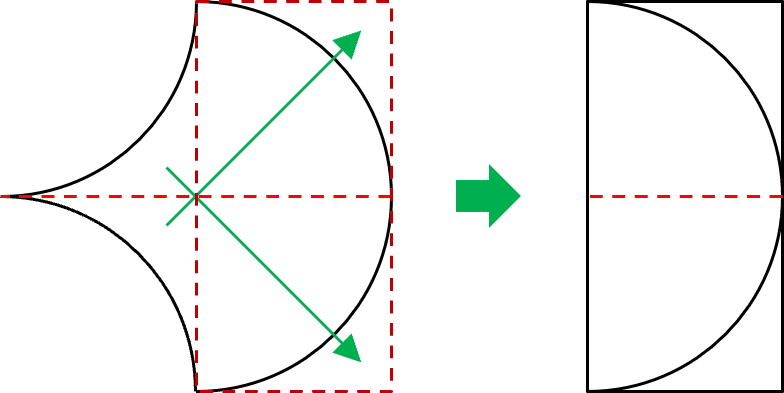
The side length of each square is equal to the small circle's radius (7 cm).
Area of 2 squares = 2 × (7 × 7) = 98 (cm²).
Instead of calculating the scattered shaded pieces individually, we can look at the big picture. The total shaded area is simply the area of the entire big circle minus all the unshaded parts.
Area of the big circle = 227 × 14 × 14 = 616 (cm²).
From part (b), we know the unshaded area inside ONE small circle is 98 cm². Since there are 4 small circles, the total unshaded area is 4 × 98 = 392 (cm²).
Total shaded area = 616 - 392 = 224 (cm²).
Wendy had some money. She spent 37 of her money on 6 identical T-shirts and 3 identical dresses.
She then spent 12 of her remaining money on a jacket.
Each dress cost $17 more than each T-shirt and the jacket cost $57 more than each dress.
(a) What fraction of Wendy's money was spent on the jacket?
Jacket : 12 × 47 = 27
Ans (a): 27
(b) What was the total amount spent on the T-shirts and dresses?
Jacket : 2 units
Let 1 T-shirt = 1 part
Dress = 1 part + $17
Jacket = 1 Dress + $57 = 1 part + $74
3 units = 6 parts + 3(1 part + $17)
3 units = 9 parts + $51
2 units = 6 parts + $34
Equate Jacket (2 units) :
6 parts + $34 = 1 part + $74
5 parts = $40
1 part = $8
3 units = 9($8) + $51 = $123
Ans (b): $123
(c) How much money did Wendy have at first?
1 unit : $123 ÷ 3 = $41
7 units : 7 × $41 = $287
Ans (c): $287
💡 Explanation for Understanding
Wendy spent her money on clothing items in two stages. We were given the fractions of money she spent, as well as how the costs of the individual items compared to each other. Our goal was to find the total amount she had at first. The main challenge was linking the fractional units of money to the actual costs of the items. A common mistake was getting overwhelmed by the different items and failing to express them using a single common variable.
Wendy spent 37 of her money on T-shirts and dresses. The remainder was 1 - 37 = 47.
She spent 12 of this remainder on the jacket. Applying the Fraction of a Remainder concept, we multiplied the two values.
12 × 47 = 27.
The jacket cost her 27 of her total money.
To compare costs easily, let the cost of 1 T-shirt be 1 part. This helped us keep our solution simple.
1 Dress = 1 part + $17.
The jacket was $57 more than a dress, so 1 Jacket = (1 part + $17) + $57 = 1 part + $74.
From our fractions, T-shirts and dresses cost 3 units. She bought 6 T-shirts (6 parts) and 3 dresses.
3 dresses = 3 × (1 part + $17) = 3 parts + $51.
Total for 3 units = 6 parts + 3 parts + $51 = 9 parts + $51.
Since 3 units was 9 parts + $51, we could easily find 2 units. A simple way was to recognize that since 3 units bought 6 T-shirts and 3 dresses, 2 units would buy 4 T-shirts (4 parts) and 2 dresses.
2 units = 4 parts + 2(1 part + $17) = 6 parts + $34.
We also knew from our fractions that the Jacket cost exactly 2 units.
We then had two different ways to express the Jacket: 1 part + $74, and 6 parts + $34. We set them equal to each other:
6 parts + $34 = 1 part + $74.
Subtracting 1 part from both sides gave: 5 parts + $34 = $74.
Subtracting $34 from both sides gave: 5 parts = $40.
1 part = $8. A single T-shirt cost $8.
This amount was 3 units, which we found earlier was 9 parts + $51.
9 × $8 + $51 = $72 + $51 = $123.
We knew 3 units = $123.
1 unit = $123 ÷ 3 = $41.
Her total money was 7 units: 7 × $41 = $287.
The figure shows the amount of water in rectangular tanks X and Y.
Tank Y contained 16 000 cm³ more water than tank X.
The height of the water level in tank Y was 16 cm more than that of tank X.

(a) Find the height of the water level in tank X.
Base Area Y : 28 × 25 = 700 (cm²)
Let h = height of water in Tank X.
Volume X = 300 × h
Volume Y = 700 × (h + 16) = 700h + 11200
Difference : Volume Y - Volume X = 16000
(700h + 11200) - 300h = 16000
400h + 11200 = 16000
400h = 16000 - 11200 = 4800
h = 4800 ÷ 400 = 12
Ans (a): 12 cm
(b) Lisa poured some water from tank Y into tank X.
The height of the water level in tank X was then the same as that of tank Y.
Find the amount of water in tank X in the end.
Volume Y at first : 700 × (12 + 16) = 19600 (cm³)
Total volume : 3600 + 19600 = 23200 (cm³)
Total Base Area : 300 + 700 = 1000 (cm²)
New equal height : 23200 ÷ 1000 = 23.2 (cm)
Final Volume X : 300 × 23.2 = 6960 (cm³)
Ans (b): 6960 cm³
💡 Explanation for Understanding
We have two rectangular tanks with different base areas containing water. We are given the exact differences in their water volumes and their water heights. Our goal is to find the starting height of the water in Tank X, and then the final volume when water is poured between them to reach the same level. The challenge is visualizing how the height difference translates to a volume difference using the base areas. A common mistake is assuming both tanks have the same base area or confusing which tank has the higher water level.
Tank X Base Area = 20 × 15 = 300 (cm²).
Tank Y Base Area = 28 × 25 = 700 (cm²).
To find the exact height, we can use simple variables to link the base areas to the volume difference.
Let the water height in Tank X be h. The volume of water in X is 300 × h = 300h.
The water in Tank Y is 16 cm higher, so its height is (h + 16). The volume of water in Y is 700 × (h + 16) = 700h + 11200.
We know Tank Y has 16 000 cm³ more water than Tank X. We subtract the volumes:
(700h + 11200) - 300h = 16000.
400h + 11200 = 16000.
Subtract 11200 from both sides: 400h = 4800.
h = 4800 ÷ 400 = 12 (cm). The height of the water in Tank X is 12 cm.
Now that we have the height, we can find the exact starting volumes.
Tank X = 300 × 12 = 3600 (cm³).
Tank Y = 700 × (12 + 16) = 700 × 28 = 19600 (cm³).
Total volume of water shared between them = 3600 + 19600 = 23200 (cm³).
When water is poured between them until their heights are perfectly level, they act like one giant combined tank. This applies the Combined Base Area concept.
Total Base Area = 300 + 700 = 1000 (cm²).
New height = Total Volume ÷ Total Base Area = 23200 ÷ 1000 = 23.2 (cm).
The water in Tank X is now resting at 23.2 cm high.
Final Volume = Base Area of X × New Height = 300 × 23.2 = 6960 (cm³).